

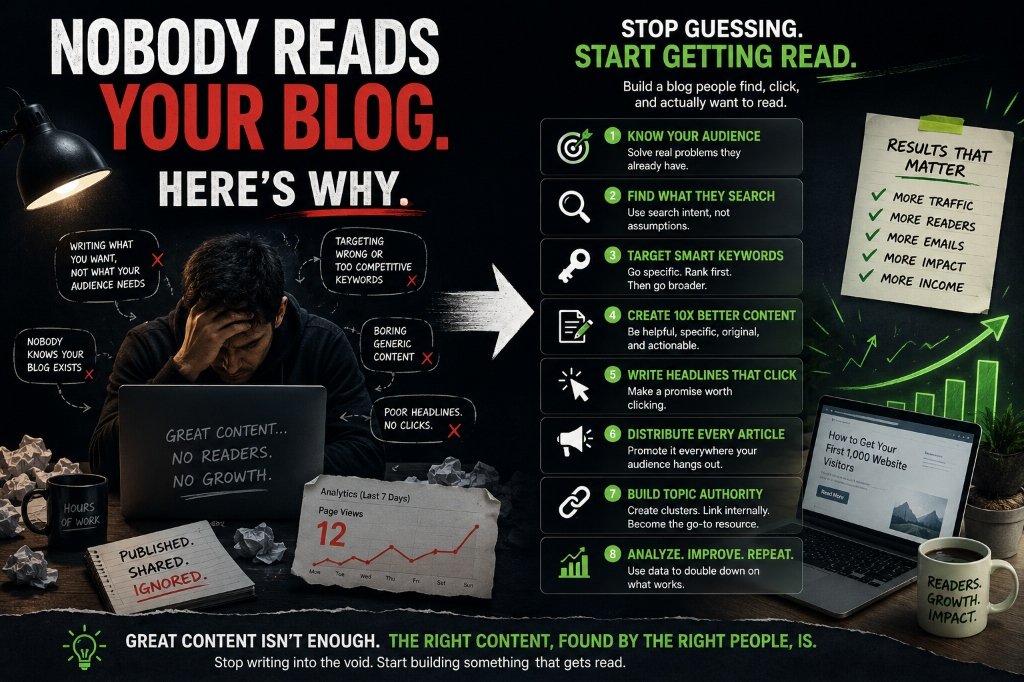

You spent three hours writing it.
You researched the topic.
You carefully chose the headline.
You added images.
You hit Publish.
Then you checked your analytics.
4 visitors.
The next day:
7 visitors.
A week later:
12.
And eventually, you start asking yourself:
"Why is nobody reading my blog?"
Here's the uncomfortable answer:
Nobody owes your blog attention.
The internet already has millions of articles competing for it.
Your audience has unlimited alternatives. Google has thousands of results. Social media gives people an endless stream of content.
So simply writing something "good" isn't enough.
If nobody is reading your blog, there's usually a reason.
Maybe you're writing about things nobody is searching for.
Maybe your headline isn't compelling.
Maybe you're targeting keywords you have no chance of ranking for.
Maybe your content is generic.
Maybe nobody knows your blog exists.
Or maybe you're solving a problem that isn't actually important to your audience.
The good news? These are fixable.
1. You're Writing What You Want to Write
This is probably the biggest mistake new bloggers make.
You have an idea. You think it's interesting. So you write about it.
But here's the problem:
Your interest doesn't automatically create demand.
Imagine you start a fitness blog and publish:
"My Thoughts on Morning Workouts"
You might have a lot to say. But compare that with:
"How to Start Running When You Have Zero Stamina"
The second article addresses an obvious problem. Someone can recognize themselves in the headline. That's what you need.
Before writing your next article, stop asking:
"What do I want to write about?"
Start asking:
"What problem does my audience already have?"
People search because they want something. They want an answer, a solution, a comparison, a recommendation, or an explanation. Your job is to find that demand and create something worth consuming.
2. Nobody Is Searching for Your Topic
You can write the best article on the internet and still get almost no Google traffic if nobody searches for the topic.
That's a brutal reality. Suppose you write:
"My Complete Philosophy of Productivity"
Maybe it's brilliant. But how many people are actually searching for that exact idea?
Now compare it with:
"How to Stop Procrastinating When You Work From Home"
There's obvious search intent. People are actively looking for an answer. This doesn't mean every article needs to be written purely for Google, but you should understand demand before investing hours into content.
Use autocomplete suggestions, "People Also Ask", related searches, Google Trends, Reddit discussions, and competitor pages to locate queries people repeatedly ask.
3. You're Targeting Keywords You Have No Chance of Ranking For
Let's say you've just started a blog about photography. You decide to write: Best Camera.
Good luck. You're competing against massive publications, retailers, manufacturers, and websites with years of domain authority.
You don't need to attack the biggest keyword first. Go narrower. Instead of "Best camera", try:
Best camera for beginner photographers under ₹50,000
Or even:
Best mirrorless camera for beginner photography under ₹50,000
Now the audience is smaller, but you're building your first foothold. Start specific, build authority, and then expand.
4. Your Headline Is Killing Your Traffic
Here's something many bloggers don't understand: Ranking doesn't guarantee readers. Someone still has to click.
Compare: "Website Traffic Strategies" with:
How to Get Your First 1,000 Website Visitors Without Paying for Ads
The second one makes a clear promise. It tells you what you'll get, how much, and what approach it takes. Your headline has one job: Make the right person want to know more.
Try structures like:
Problem: Nobody Reads Your Blog. Here's Why.
How-to: How to Get Your First 1,000 Website Visitors
Number: 7 Reasons Your Blog Isn't Getting Traffic
Contrarian: Stop Writing More Blog Posts. Do This Instead.
But don't turn your headlines into clickbait. A high-click headline followed by disappointing content will hurt your credibility.
5. Your Content Is Generic
This is where a lot of blogs die. You search a topic, read the first five articles, and rewrite them in your own words. You've created the sixth article saying exactly the same thing.
The internet doesn't need another generic "10 Tips for Better Productivity". It needs something better.
Add elements others ignore:
Original research or data
Personal experience and screenshots
Real comparisons and case studies
Actionable templates and frameworks
Don't just tell readers to "be consistent" or "use SEO". Show them exactly how you found the keyword, or what your consistency system looks like. Specific beats generic every time.
6. You're Writing for Google Instead of Humans
Some bloggers become obsessed with keywords. They stuff them everywhere. Suddenly their article sounds like this: "If you're looking for the best running shoes, these best running shoes are among the best running shoes..."
Stop. You're writing for a person. Use keywords naturally, structure your article clearly, explain things simply, and most importantly: Actually help the person who clicked. SEO should help people discover your content, not make it painful to read.
7. Your Introduction Is Too Slow
You have seconds to convince someone to continue. Yet many blog introductions begin with: "Since the beginning of time, humans have always been interested in..."
Please don't. Get to the point. A strong introduction should quickly establish: The problem → why it matters → what you're going to solve. Don't make readers dig through five paragraphs to find out why they should care.
8. Your Article Is Difficult to Read
Even great information can become unreadable in one giant wall of text with no headings, bullets, or visual breaks.
Your blog should be designed for scanning. Use short paragraphs, clear H2/H3 headings, bullet points, numbered steps, bold emphasis, and tables or images. Make scanning easy for readers before they decide to read deeper.
9. Nobody Knows Your Blog Exists
Publishing isn't marketing. You need distribution. One article can be repackaged for different platforms:
1 blog post → LinkedIn post → X/Twitter thread → Instagram carousel → Email → Reddit discussion → Pinterest graphic
You're not creating eight different ideas. You are distributing one useful idea in different formats. Your blog is the asset; your distribution channels are the hooks.
10. You're Waiting for Google to Save You
Publishing and waiting without building momentum is a common trap. SEO is a compounding game. One article might generate 20 visitors/month, another 50, another 300, and another 2,000.
The goal isn't to make every article a winner. The goal is to keep increasing the number of high-quality entry points. Twenty useful articles can outperform one "perfect" article.
11. You're Not Building Topic Authority
Instead of randomly publishing whatever idea comes into your head, build content clusters. For a photography blog, your main topic could be: Photography for Beginners, supported by:
How to Choose Your First Camera
Aperture and Shutter Speed Explained
Best Lenses for Beginners
How to Edit Your First Photos
This links your articles to one another, helps readers go deeper, and establishes topical depth with search engines.
12. You're Not Giving Readers a Reason to Stay
Getting someone to click is only the beginning. Why would this person read another article after finishing this one? Create a path. Link to relevant follow-up articles (e.g. from "How to Start Running" to "Best Running Shoes"). Internal links are navigation and recommendations.
13. You're Measuring the Wrong Thing
Celebrating 10,000 pageviews is meaningless if nobody subscribed, clicked your CTA, or returned. Traffic is useful, but relevant traffic is better. Focus on attracting the right people who engage with your site.
14. You're Not Updating Your Best Content
Sometimes you don't need another article. You need to improve what you already have. Find pages ranking #10-#15 in search and add missing info, refresh data, improve headings, and strengthen links to push them into top rankings. Make what already works better.
15. You're Trying to Go Viral Instead of Becoming Useful
You don't need a viral post that brings spike traffic for one day. You need a repeatable system. A library of 50 useful articles keeps bringing people every day. Treat each article like a small acquisition machine.
The 5-Question Test
Before you publish your next article, ask yourself:
Does someone actually want this?
Can I realistically compete for this topic?
Is my headline worth clicking?
Am I saying anything new?
What should the reader do next?
The Real Problem Isn't That Nobody Reads Your Blog
It isn't because you're a bad writer or blogging is dead. It's because you are creating without demand, targeting the wrong keywords, or ignoring distribution. And every one of these problems can be fixed.
Stop asking "What should I write?" and start asking "What is my audience struggling with?" That's the shift that goes from 0 readers to 10,000+.
Related ResourcesFree Press Release Templates (2026)30+ TV Channels at a Mumbai Press Conference: The Full Story→ PR & Media Relations Services→ View Media Mirch Case Studies
PLAN YOUR PR STRATEGY WITH MEDIA MIRCH
From media list curation and press release writing to national TV campaigns — we handle the entire process so you can focus on your message.

