

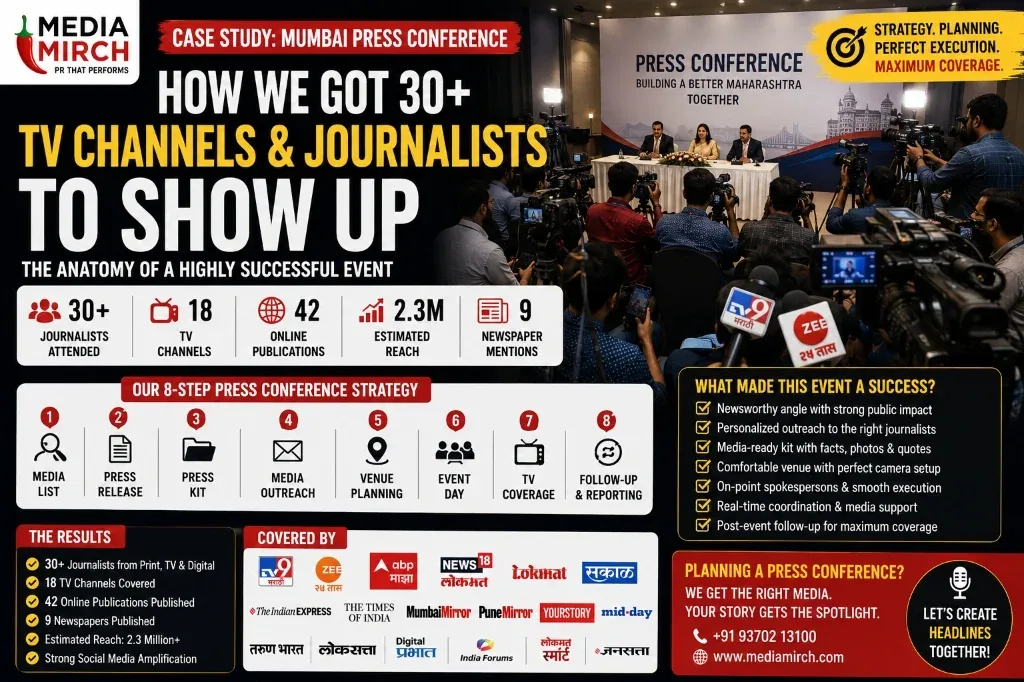
There is a moment every PR professional dreads: standing at the entrance of a press conference venue five minutes before the scheduled start, watching the seats remain empty. Journalists are busy. Their inboxes are a warzone. And a half-attended press conference doesn't just waste your client's budget — it damages their credibility.
We know this problem intimately. It is why, at Media Mirch, we built a repeatable, relationship-first process for press conference management in Mumbai and across Maharashtra. This case study is a transparent look at exactly how we executed one such event — and how every decision, from the media list to the post-event follow-up, contributed to a room full of cameras and notebooks.
The Challenge: Why Getting Journalists to Attend Is Harder Than It Looks
If you believe that sending an invitation is enough to fill a press conference, you are operating in a different decade. The media landscape in Mumbai in 2026 is defined by extreme competition for journalist attention. Understanding the structural barriers is the first step to overcoming them.
Hundreds of Invitations Ignored Daily
A senior journalist at a Mumbai-based Marathi TV channel told us they receive between 40 and 80 press conference invitations every week. The vast majority are ignored. The ones that get opened have either a compelling subject line, come from a familiar name, or carry genuine news value.
Generic Press Releases Don't Work
A press release that reads like a corporate brochure is a press release that goes straight to the trash folder. Journalists are trained to detect promotional language in seconds. The moment they read "a leading innovator in the space announces a paradigm shift," the email is done.
Last-Minute Invitations Fail
Journalists plan their schedules days in advance. An invitation sent 24 hours before the event — regardless of how important the news is — will almost always fail because the journalist is already committed elsewhere.
Lack of Established Media Relationships
The hardest thing to buy is trust. When a journalist recognises the PR firm's name and knows their past events have been worth covering, they are far more likely to clear their calendar. Cold outreach to journalists who don't know you has an extremely low conversion rate.
Poor Event Planning Creates Avoidable Problems
Venues without proper camera positions, events without a media spokesperson, and press conferences that run two hours late all result in journalists leaving early, filing incomplete stories, and never returning your calls again.
About This Press Conference
Before going into the strategy, here is the context for this specific event:
Parameter | Details |
|---|---|
Industry | Social Impact / Corporate CSR |
Location | Andheri West, Mumbai |
Objective | Launch of a Maharashtra-wide community initiative |
Audience | TV, print, digital, and social media journalists |
Event Duration | 2.5 hours (including media interaction) |
Planning Timeline | 21 days from brief to event day |
This was not a Fortune 500 company launching a product. It was a cause-driven initiative with genuine public interest — which is actually the ideal scenario for press conference success, because journalists are looking for stories their readers and viewers care about.
The Goal: Measurable Objectives, Not Vague Hopes
One of the most common PR failures is organizing a press conference without defining what success actually looks like. Before a single invitation was drafted, we established concrete, measurable targets:
30+ verified journalists physically present at the venue
Minimum 10 TV channels including at least 5 Marathi language channels
Coverage in 3+ print newspapers (Marathi and English combined)
Coverage in 20+ digital publications within 48 hours of the event
Active social media amplification during and after the event
Post-event media report delivered to the client within 5 working days
These targets forced us to be strategic about every element of the event — from who we invited to how we designed the room layout.
Step 1: Building the Right Media List
A media list is not a spreadsheet of every journalist you've ever met. A useful media list is a curated database of beat-specific journalists whose editorial interests align with your story. For this event, we built the list from the ground up, not from a generic database.
TV Channels (Mumbai & Maharashtra)
We targeted 35 TV channel contacts across Marathi and Hindi news. Priority was given to channels with dedicated social affairs, community, and Maharashtra-state desks:
Zee 24 Taas, ABP Majha, TV9 Marathi, Saam TV, News18 Lokmat (Marathi priority)
NDTV India, Aaj Tak, India TV (Hindi national)
DD Sahyadri (government / Doordarshan Maharashtra)
Newspapers
Marathi: Lokmat, Sakal, Maharashtra Times, Pudhari, Tarun Bharat
English: Times of India (Mumbai), Hindustan Times, The Indian Express, Mid-Day
Digital Media
Maharashtra-focused portals: Maharashtra Times Online, Loksatta.com, News18 Lokmat Digital
National digital: The Wire, Scroll, The Print, Outlook India
Niche portals aligned to the event's theme
Beat-Specific vs. General Reporters
We specifically sought reporters who covered the subject area, not just general city reporters. A reporter who writes about community development will pitch harder for your story internally than a general-assignment reporter who sees 50 similar events a year.
Local vs. National Priority
For a Mumbai-specific initiative, local Marathi media always take priority. A Zee 24 Taas piece has more impact on Maharashtra public sentiment than a brief mention in a national English daily.
Media Mirch Tip:We cross-referenced our list against journalists who had previously covered similar events in Maharashtra — their published articles confirmed genuine beat interest, not just job title alignment.
Step 2: Writing a Press Release That Gets Opened
The press release for this event was not a document we wrote in 20 minutes. It went through three editorial passes before it was approved for distribution. Here is the framework we use:
Headline: The Make-or-Break Moment
Your headline is competing with 40–80 other subject lines in a journalist's inbox. It must answer the question: "Why should I cover this story today?"
We avoid vague, promotional headlines. Instead, we lead with the news itself — a number, a name, a concrete outcome, or an unexpected angle.
❌ Weak: "XYZ Organization Announces Maharashtra Initiative"
✅ Strong: "5,000 Families in Rural Maharashtra to Receive Free Health Screening Under New NGO Programme"
First Paragraph: The Five W's
Any journalist should be able to read only the first paragraph and understand the complete story: Who, What, Where, When, and Why — in three sentences or fewer.
Quotes That Sound Human
AI-generated or committee-approved quotes that sound like corporate policy statements do not get published. Journalists look for quotes that add context, emotion, or a fresh perspective. We wrote and approved the spokesperson's quote before the press release was drafted around it.
Statistics & Proof Points
Numbers anchor a story in reality. We included verifiable data on the scale of the initiative, beneficiary demographics, and funding sources — giving journalists factual scaffolding to build their stories quickly.
The Marathi Language Version
We always produce a Marathi-language version of the press release for Marathi media. This is not a translation — it is a re-write for regional editorial sensibility. Marathi journalists publish regional-language content faster and more prominently when it arrives in their language, not as an English article they need to translate themselves.
Step 3: Designing the Press Kit
A press kit signals professionalism. It tells journalists that the organizing team has done the work so they don't have to. A well-prepared press kit dramatically reduces the time journalists need to write their story — which increases the likelihood that they will.
Our press kit for this event included:
Press Release — English version (editable Word document) and Marathi version
Organization Profile — 300-word backgrounder on the client organization
Speaker Bios — Short, third-person bios for each speaker with high-resolution headshots
Fact Sheet — Key initiative statistics in bullet-point format for rapid reference
High-Resolution Images — Pre-event images, infographics, and the media backdrop design
Logos — SVG and PNG formats of all relevant organizational logos
Media Contact Details — Direct mobile number and WhatsApp of the assigned Media Mirch coordinator
All files were uploaded to a shared Google Drive folder and the link was included in every outreach email. No large attachments — journalists hate downloading files that clog their inbox.
Step 4: The Journalist Outreach Strategy
This is where the execution separates experienced PR professionals from amateurs. Outreach is not a one-time email blast. It is a structured, multi-channel communication sequence designed to move journalists from awareness to confirmed attendance.
Day | Action | Channel |
|---|---|---|
Day 1 (D-14) | Formal invitation + press release + press kit link | |
Day 3 (D-12) | Warm follow-up with exclusive angle for key journalists | Email + WhatsApp |
Day 7 (D-7) | Second follow-up, RSVP confirmation request | |
Day 11 (D-3) | Reminder with updated details, camera position info for TV | Email + WhatsApp |
Day 13 (D-1) | Personal phone call to priority unconfirmed journalists | Phone Call |
Day 14 (Event Day) | Morning WhatsApp reminder with venue map pin |
The Exclusive Angle Approach
For our three highest-priority journalists (one Marathi TV journalist, one English print journalist, one digital platform editor), we offered a 15-minute exclusive briefing with the client's spokesperson the day before the event. This is not standard practice, but it is extraordinarily effective. Journalists who receive advance access feel ownership over the story — they show up because they are now invested in it.
RSVP Tracking
We maintained a live RSVP tracker categorizing journalists as Confirmed, Tentative, No Response, and Declined. This dashboard told us exactly where to focus our follow-up energy each day — not on those who had already confirmed, but on the undecided fence-sitters.
Step 5: Choosing the Right Venue
The venue is not just a backdrop. For a press conference, it is a production environment that will directly affect the quality of TV footage, the comfort of journalists, and the efficiency of the overall event.
What We Look For in a Mumbai Press Conference Venue
Accessibility: Within 500 metres of a metro station or with dedicated parking. Journalists who struggle to find the venue or can't park leave early and don't come back.
Camera Setup: A raised platform or clear 180-degree sightlines to the main stage, free of obstructions, with at least 6–8 metres of depth for TV cameras on tripods.
Media Backdrop: A professional branded backdrop (step-and-repeat) behind the speakers — essential for TV shots and photographs. Without it, TV channels get unusable footage.
Registration Desk: A separate, clearly marked media registration area with name-badge collection to control entry and track attendance for post-event reporting.
Sound System: Professional-grade PA system with a dedicated audio feed for TV crews to connect their recording equipment directly.
Ambient Light: Natural or controllable artificial lighting that does not create unflattering shadows on the stage. Poor lighting is a common reason TV channels re-file from a press conference without usable visuals.
For this event, we selected a hotel banquet hall in Andheri West — centrally located, professionally equipped, and familiar to the city's press corps.
Step 6: Event-Day Execution
The best media list and the best press release are undone by poor event-day execution. Our on-ground team operates on a detailed run-of-show document that leaves nothing to improvisation.
Registration & Arrival
Our team arrived 90 minutes before journalist arrival time. The registration desk was staffed with two coordinators: one for name badge collection, one for press kit distribution. A WhatsApp group for confirmed media was created two days prior and used to share last-minute logistics updates.
Media Coordination
A designated Media Mirch coordinator was assigned to TV crew logistics — managing camera positions, coordinating audio feed connections, and ensuring no channel blocked another's sightline. This role sounds minor. It is not. Poor camera coordination is one of the most common reasons TV channels file from a press conference without usable footage.
Stage Management
A detailed speaker briefing was held 30 minutes before the event began. Each speaker was given their precise time slot, their key messages in bullet-point format, and explicit instructions about pausing for photography and avoiding rapid movement that makes TV footage difficult to edit.
Photography & Videography
Our in-house photographer and videographer were positioned to capture clean, usable content from the event's first minute. This content was edited and distributed to media contacts within 6 hours of the event's close — allowing digital publications to publish with original visuals.
Live Social Media Coverage
A dedicated social media coordinator posted live updates to the client's Instagram, X (Twitter), and LinkedIn during the event. Real-time coverage builds momentum and extends the event's reach beyond the room.
Step 7: Making TV Coverage Easy
TV journalists operate under brutal time pressure. They need to return to their bureau, edit footage, record a stand-up, and have their segment ready for the evening bulletin — often within two to three hours of the event ending. Your job as the PR organizer is to make their work as simple as possible.
Dedicated Interview Zones
We set up two dedicated one-on-one interview zones adjacent to the main hall, with branded backdrops and clean lighting. After the formal event concluded, each TV channel was offered a dedicated 5-minute one-on-one with the primary spokesperson. This is the content that makes it into evening bulletins.
Lighting Setup
Softbox lights in the interview zones ensured clean, flattering footage regardless of the ambient room lighting. This is a professional detail that many press conferences overlook — and TV journalists notice when it's missing.
Audio Quality
A clip-on microphone feed was available for TV crews to plug into directly, eliminating the need for boom operators to compete for position in a crowded room.
Ready-Made Sound Bites
We pre-wrote three concise, quotable sound bites for the spokesperson — each under 25 seconds, each addressing a different angle (social impact, organizational vision, call to action). These were rehearsed until they sounded natural. Sound bites that fit cleanly into a 90-second news segment get used. Rambling, unprepared answers do not.
B-Roll Opportunities
We arranged for B-roll footage to be shot before and after the event — relevant visuals that TV editors can cut away to while the narrator is speaking. A press conference without B-roll forces editors to use static talking-head footage for the entire segment, which they hate.
Step 8: After the Event — The Follow-Up That Most Agencies Skip
The follow-up is where most PR agencies fail. The event ends, the team packs up, and the client is left wondering what actually happened. Our post-event process is as structured as the pre-event outreach.
Within 6 Hours of the Event
High-resolution event photographs distributed via Google Drive to all attending journalists
Edited video clips (60-second highlights) shared for digital publication use
Full-length interview recordings shared with TV contacts who requested them
Within 24 Hours
Personalised thank-you messages to every journalist who attended — via WhatsApp and email
Additional information or data requested during Q&A sent promptly
Coverage tracking begins: monitoring print, digital, TV, and social for mentions
Within 72 Hours
Follow-up to journalists who attended but have not yet filed stories — offering additional quotes, statistics, or interview access if needed
A courtesy note to journalists who confirmed but couldn't attend — sharing the press kit again with a standing offer for a follow-up interview
Within 5 Working Days
Comprehensive post-event media coverage report delivered to the client, including all clippings, links, TV segment screenshots, estimated reach, and PR value
The Results
Here is what the event actually delivered — in measurable, verifiable numbers:
34Journalists Attended18TV Channels42Online Publications9Newspaper Mentions2.3MEst. Total Reach150+Social Media Shares
Every original target was met or exceeded. The event generated television coverage on 8 Marathi-language channels in their prime-time evening bulletins — the format that reaches the largest daily audience in Maharashtra.
Lessons We Learned From This Event
1. Timing Matters More Than Most People Realize
We scheduled the event at 11:00 AM — late enough for journalists to complete their morning rounds, early enough to file for afternoon and evening news cycles. Events at 5:00 PM or later almost always have poor TV attendance because evening bulletins are already being produced.
2. Exclusive Angles Drive Attendance
The three journalists who received advance briefings all showed up and all filed stories. Their colleagues, hearing that a competitor had advance access, were motivated to attend to avoid being scooped. Competition among journalists works in your favour when you use exclusives strategically.
3. Relationships Outperform Mass Emailing
Of the 34 journalists who attended, 22 came because of a direct personal relationship with our team or a relationship-based WhatsApp message. Only 12 came from cold email outreach. The ROI on relationship-building in PR is extraordinary — but it takes years to develop.
4. Preparation Reduces Last-Minute Crises
We ran a full tech check 90 minutes before the event. We found two non-functional microphones and a backdrop that was mounted 15 cm off-centre. Both were fixed before any journalist arrived. These are the invisible problems that, if left unresolved, create visible failures during the event.
5. Follow-Up Is as Important as the Invitation
Of the 42 online publications that covered the event, 11 published their stories only after receiving our follow-up materials — including original photographs — after the event concluded. Without the follow-up, we would have gotten 31 publications, not 42.
Common Mistakes Businesses Make When Organizing Press Conferences
These are the errors we see most frequently when clients come to us having already attempted to organize their own press conference:
Sending invitations too late. Anything less than 7 days' notice is almost always insufficient. Ten to fourteen days is the professional standard for a significant event.
No designated media spokesperson. A press conference without a single articulate, prepared spokesperson is a disaster waiting to happen. Every speaker needs to be briefed. Only one should handle all media Q&A unless specifically directed otherwise.
Weak, non-newsworthy headlines. If your press release headline could apply to any company in any industry on any day of the week, it is not a news headline. It is a marketing tagline. Journalists need a genuine news hook.
Poor venue choice. Venues in difficult-to-reach locations, without parking, or with inadequate lighting and sound facilities will result in journalists leaving early and camera crews filing unusable footage.
No press kit. Expecting journalists to reconstruct your story without a press kit forces them to use only what they noted during the event. This produces shallow, inaccurate coverage.
No post-event follow-up. Failing to share photographs, video clips, and additional information after the event means missing a significant portion of potential coverage from journalists who attended but hadn't filed yet.
Why Media Relationships Change the Outcome
We want to be direct about something that most PR agencies avoid saying out loud: media coverage is never guaranteed. No PR firm — regardless of how many "guarantees" they claim to offer — can force an editorial team to publish a story. Journalists and editors make independent decisions based on news value, audience relevance, and their own editorial judgment.
What established media relationships change is not the guarantee — it is the probability. When a journalist knows your name, trusts that your events are worth attending, and has a positive history of working with your team, they are significantly more likely to:
Open your invitation rather than deleting it unread
Attend even when their schedule is tight
Prioritize filing the story when competing deadlines arise
Call you for quotes on future stories in your client's domain
These relationships are built over time, through consistent professionalism, honest communication, and never wasting a journalist's time with events or stories that lack genuine news value. They cannot be purchased and they cannot be replicated with a media database subscription.
Important note:Media Mirch does not guarantee coverage. We guarantee a professional, ethical, and strategically executed process that maximises your probability of achieving meaningful media attendance and post-event coverage.
Planning a Press Conference in Maharashtra? Here's What We Offer
Media Mirch is a full-service PR and media relations agency based in Pune, operating across Maharashtra including Mumbai, Nashik, Aurangabad, and Nagpur. Our press conference services include:
📋Press Conference Planning
End-to-end event strategy, run-of-show design, and logistics coordination.
📰Press Release Writing
English and Marathi press releases written to editorial standards, not marketing standards.
👥Journalist Coordination
Media list building, multi-channel outreach, RSVP tracking, and on-day media management.
📺TV Media Management
Camera position management, audio feed setup, interview zone production, and TV-ready sound bites.
📷Photography & Videography
Professional event documentation with same-day distribution to media contacts.
🌐Digital PR & Coverage Reports
Post-event coverage tracking, media clipping reports, and estimated reach analytics.
We have organized press conferences for NGOs, startups, political foundations, sports organizations, entertainment productions, and corporate clients across Maharashtra. Each event is planned as if our own reputation is on the line — because it is.
Frequently Asked Questions
How much does a press conference cost in Mumbai?
A professionally managed press conference in Mumbai typically ranges from ₹50,000 to ₹5,00,000+ depending on venue, the number of journalists targeted, AV requirements, photography and videography, and post-event coverage reporting. Basic execution (press release, outreach, on-day coordination) can be done at lower cost; full-service management with venue selection, branded backdrop production, photography, and a comprehensive coverage report sits at the higher end. Contact Media Mirch for a tailored quote specific to your event goals.
How many journalists usually attend a press conference?
Attendance varies widely based on the news value of the event, the quality of outreach, and the strength of existing media relationships. A well-planned press conference by an experienced PR agency in Mumbai can attract 20 to 60+ journalists. The realistic average for a mid-scale corporate or social event, with a proper media list and structured outreach, is 25–35 journalists.
How early should invitations be sent?
Formal invitations should go out 10–14 days before the event. A WhatsApp reminder should follow at D-3, and a final confirmation call or message on the morning of the event. Anything less than 7 days' notice significantly reduces the probability of strong attendance.
Can startups organize a press conference in Mumbai?
Yes — but only if they have a compelling news angle. A funding announcement, a product that solves a visible local problem, a high-profile partnership, or a social initiative with genuine impact can generate strong media interest even for an unknown startup. The story drives attendance, not the brand size. What startups typically lack is established media relationships — which is where a PR agency provides the most value.
Which TV channels cover business events in Mumbai?
For Maharashtra-region coverage, Zee 24 Taas, ABP Majha, TV9 Marathi, Saam TV, and News18 Lokmat are the primary Marathi-language channels. For English and national Hindi coverage, NDTV India, Aaj Tak, India TV, CNBC-TV18, and ET Now cover significant corporate announcements. DD Sahyadri covers government and public-interest events.
Do you organize press conferences outside Mumbai?
Yes. Media Mirch organizes press conferences and media events across Maharashtra including Pune, Nashik, Aurangabad, Kolhapur, and Nagpur, with established media relationships and local vendor networks in each city.
Do you provide a media coverage report after the event?
Yes. Every press conference engagement includes a comprehensive post-event media coverage report delivered within 5 working days. The report includes all print clippings (with photographs), digital publication links, TV coverage screenshots or clips, estimated reach calculations, and a PR value summary.
Final Thoughts
A press conference is one of the most powerful tools in a PR professional's arsenal — and one of the most misused. When it is executed poorly, it wastes budget, damages credibility, and reinforces the mistaken belief that "the media doesn't come." When it is executed well, it can establish a brand's public presence, introduce a new initiative to hundreds of thousands of readers and viewers, and create media relationships that deliver value for years.
The 8-step strategy outlined in this case study is not a template to be copy-pasted. It is a framework that must be adapted to each client's news value, market, timing, and goals. What doesn't change is the principle underneath it: journalists come when they believe your story is worth their audience's time. Your entire job, as a press conference organizer, is to make that case — clearly, early, and repeatedly.
If you are planning a press conference in Mumbai, Pune, or anywhere in Maharashtra and would like to speak with our team about how we would approach your specific event, we are available for a free 30-minute consultation.
Plan Your Mumbai Press Conference With Media Mirch
From media list curation and press release writing to on-day TV management and post-event coverage reports — we handle the entire process so you can focus on your message.
Book a Free ConsultationView Our ServicesRelated ResourcesFree Press Release Templates (2026)→ Media Relations & Press Release Writing Services→ View All Case Studies→ Contact Media Mirch for Event PR Services
PLAN YOUR PR STRATEGY WITH MEDIA MIRCH
From media list curation and press release writing to national TV campaigns — we handle the entire process so you can focus on your message.

