

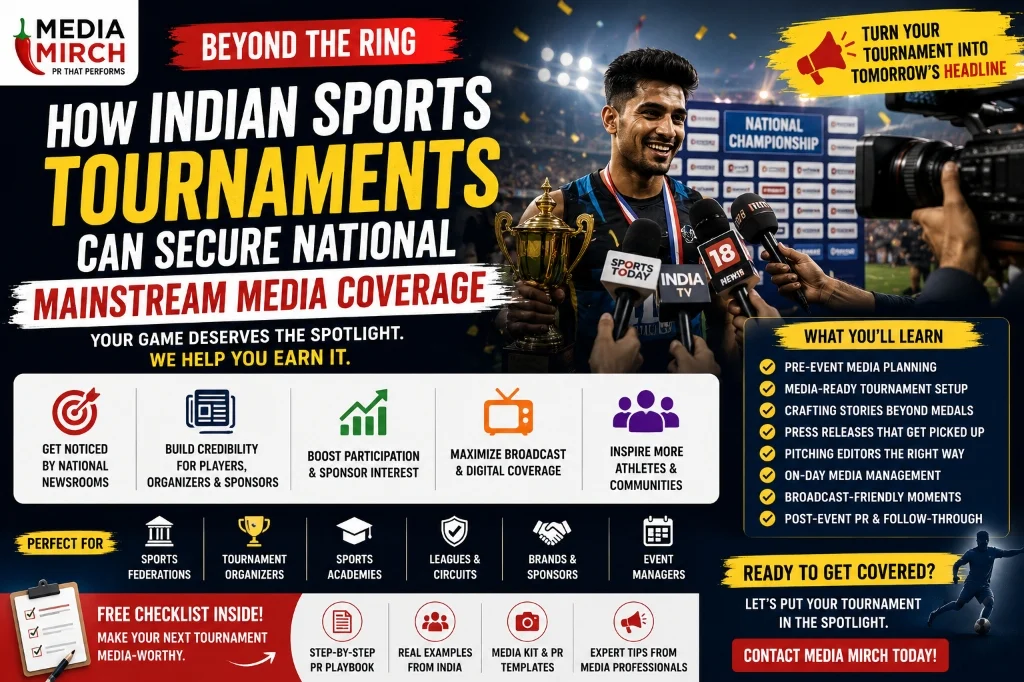
India hosts thousands of sports tournaments every year — from inter-district kabaddi competitions and state-level boxing championships to national wrestling circuits and open-category shooting meets. The athletes who compete in these events are often dedicated, talented, and deserving of recognition. Their stories — sacrifice, resilience, community pride, and athletic excellence — are exactly the kind of content that sports journalists want to publish.
Yet most of these events receive no meaningful media coverage. Not because the sport is unimportant. Not because the journalists don't care. But because the organizers have never been taught how media actually works — and what it takes to make a sports event genuinely newsworthy.
This guide will change that. It is written specifically for sports federations, academy directors, tournament organizers, league administrators, and the brands that sponsor them. By the end, you will understand the exact steps Media Mirch uses to turn regional Indian sports events into national media stories.
Why Most Sports Events Never Make the News
Before you can fix a problem, you have to understand it accurately. Here are the real reasons Indian sports tournaments fail to generate coverage — and none of them are "the media doesn't care about our sport."
Great Competition Doesn't Automatically Become News
A fierce semi-final match, a record-breaking performance, or a rare upset — these are compelling sporting moments. But they are not, by themselves, media stories. Journalism is storytelling, not reporting facts. A journalist needs a narrative frame: who is this athlete, why does their victory matter, what does it represent beyond the scoreboard? Without that frame, even the most dramatic match is just a result.
Journalists Need Stories, Not Schedules
The most common mistake sports organizers make is sending journalists a tournament schedule and expecting coverage. Schedules are administrative documents. Journalists are storytellers. Sending a fixture list to a sports desk is like sending an ingredients list to a restaurant critic and expecting a review.
Newsrooms Have Limited Sports Resources
Outside of cricket, most Indian newsrooms assign a small number of reporters to cover all other sports combined. These journalists have to prioritize. They will choose the events where the story is already half-written for them — because their time is too limited to start from scratch every time.
Cricket Dominates the Available Space
This is real and it is not going away. For every sports story published in India on any given day, 60–70% involve cricket. The remaining space is divided among football, kabaddi, wrestling, hockey, boxing, badminton, and dozens of other sports. Your event has to make a compelling argument for why it deserves that limited space today.
Generic Press Releases Go Straight to Delete
Most sports press releases in India follow a predictable format: tournament name, date, location, organizing body, a quote from a patron or official, and a list of participating states. This is an administrative document, not a media pitch. It contains no human story, no news hook, and no reason why a reader would care. Sports journalists delete dozens of these every week without opening them.
Understanding How Sports Editors Think
If you want journalists to cover your event, you need to see it through their eyes. Sports editors are asking one question about every story pitch they receive: "Why will my readers or viewers care about this — today?"
Here are the specific elements that make a sports story editorially strong in India:
❤️Human-Interest Stories
Athletes who overcame poverty, illness, family loss, or disability. These stories transcend sport and reach general audiences.
🏆Records & Milestones
Youngest champion, oldest participant, first woman to win, national record broken. Numbers are an editor's shortcut to significance.
⬆️Underdog Athletes
A team from a small district beating a state-funded academy. An unsponsored athlete defeating a national medallist. Upset stories write themselves.
🌍Community Impact
A tournament that employs local vendors, trains local youth coaches, or raises funds for a community cause becomes a civic story, not just a sports story.
🇮🇳National & Olympic Pathways
If your event is a qualifying pathway for national championships or Olympic selection trials, that context makes every participant's performance more newsworthy.
♀️Social Relevance
Women's events in male-dominated sports, tournaments in conflict or flood-affected regions, para-sports inclusion — all carry social narrative weight beyond the results.
⭐Celebrity Participation
A Bollywood actor flagging off an event, a former national champion mentoring participants, a political figure inaugurating a rural tournament — all extend editorial reach immediately.
The Media Mirch Principle:Every sports tournament has at least three media-worthy stories inside it. Your job is to find them before the tournament begins — not look for them after the final whistle.
Start Media Planning Before the Tournament Begins
Media strategy is not something you begin three days before an event. Done correctly, it starts the moment the tournament date is confirmed. Here is the framework we use:
Define Your Media Objectives First
Before identifying a single journalist, answer these questions: What do we want coverage to achieve? Sponsor visibility? Athlete recognition? Public registration interest? National federation attention? Different objectives require different media strategies, different target publications, and different story angles.
Identify Target Publications by Beat and Relevance
Build your media list around beat alignment, not just circulation numbers. A reporter who covers combat sports every week is ten times more valuable than a general sports desk at a larger publication — because they understand your sport, have an audience for it, and are looking for content in your space.
Prepare a Media Calendar With Milestone Announcements
Timeline | Media Action |
|---|---|
D-30 | Tournament announcement press release with dates, format, and unique story angle |
D-21 | Feature pitch to national sports publications (athlete profiles, historical context) |
D-14 | Media accreditation opens; formal press conference (if warranted) |
D-7 | Pre-event human-interest story planted with a target publication |
D-3 | Final media confirmation calls; event logistics sent to all accredited journalists |
Event Day(s) | Live social media, on-site media coordination, interview scheduling |
D+1 | Results press release + photo distribution + thank-you to all attending media |
D+5 | Post-event coverage report delivered; follow-up stories pitched to feature desks |
Building a Media-Ready Tournament
The physical design of your event significantly affects the quality and quantity of coverage it receives. These are not production luxuries — they are media infrastructure decisions.
Professional Branding Throughout the Venue
Every photograph taken at your event is a branding opportunity. Ensure sponsor boards, tournament banners, and branded backdrops appear in every natural camera angle. A photographer covering a boxing bout should never be able to capture a clean image without at least one sponsor or tournament brand element in frame.
Media-Friendly Venue Layout
Consider the journalist's physical experience. Where will they sit? Can they see the competition area clearly? Is there power for their laptops? Is there a media table with Wi-Fi? These details determine whether a journalist files from inside your venue or leaves early to file from a café down the road.
Dedicated Interview Spaces
A branded interview backdrop, positioned away from ambient crowd noise, with clean lighting and sufficient space for a camera crew and microphone, is non-negotiable for events seeking TV coverage. Without it, TV channels cannot produce professional-quality content from your event.
Broadcast-Friendly Stage Design
Award ceremonies, opening ceremonies, and final-round competition should be staged with broadcast in mind. This means: elevated podiums visible from the media gallery, clean sightlines from multiple camera positions, a PA audio feed available for broadcast crews, and a schedule that allows adequate preparation time for the broadcast team.
Athlete Interaction Zones
Create a structured post-match zone where athletes are available for brief media interactions immediately after competition. This is where the best sports journalism happens — raw, emotional, immediate. Coaches who pull athletes away before journalists can speak to them are the single biggest source of lost sports coverage in India.
Finding Stories Beyond the Medal Winners
The gold medallist will always be covered. Your job is to find the ten stories happening around the medals that are equally compelling — often more so. Here are the story types we actively look for when managing sports events:
Young Prodigies: A 14-year-old competing in the open category. A teenager training without a coach because their village has no sports facility. Youth athletes with exceptional natural talent who lack institutional support are consistent editorial favourites.
Comeback Stories: An athlete returning after injury, after years out of the sport, after personal tragedy. The emotional arc of a comeback is a complete story with a beginning, middle, and end.
Athletes Overcoming Adversity: Physical disability, family poverty, geographic isolation, and systemic lack of access are all narratives that editors know their readers will engage with deeply.
Women in Sports: Women competing in traditionally male-dominated sports, female coaches in combat sports, all-women organizing committees for a national tournament — all carry social significance beyond athletic performance.
Rural Talent: An athlete from a village who has never seen a proper training facility, competing alongside professionals funded by academies and state associations, is one of the most reliable stories in Indian sports journalism.
Veteran Competitors: Athletes in their 40s or 50s still competing at serious levels, often while working full-time jobs and raising families. These stories have enormous reader identification.
Para-Athletes: Inclusion of para-athletes in a mainstream tournament — or a dedicated para-sports division within your event — is almost guaranteed to generate feature-level coverage if communicated correctly.
Family Sacrifices: Parents who mortgaged their house for equipment, siblings who gave up their own education to support a brother or sister's training, grandparents who coach because no qualified coach exists. These are Indian stories in their purest form.
Local Heroes: An athlete from the host city or district competing on home ground. These stories have guaranteed local media relevance and generate community pride that extends far beyond the sports pages.
Action item:Before your tournament begins, interview 5–10 registered athletes and document their backgrounds. You will almost certainly find two or three stories that are genuinely national-quality features.
Creating a Professional Press Kit
A press kit for a sports tournament is not a sponsorship brochure. It is a working document designed to help journalists write accurate, complete stories without needing to contact you for every detail. The faster a journalist can write their story, the more likely they are to write it.
A complete sports tournament press kit should include:
Tournament Overview: One-page summary of the event's history, significance, format, and this year's edition. Written in journalistic style, not promotional language.
Fact Sheet: Key data in bullet format — number of participants, states represented, age categories, prize structure, qualification pathway, organizing body.
Event Schedule: Day-by-day programme with key sessions highlighted for media coverage priority.
Athlete Profiles: Two-paragraph profiles of 5–8 key athletes with photographs, personal background, career highlights, and a direct quote. These become the raw material for feature stories.
High-Resolution Images: Minimum 8–10 images from previous editions or from pre-tournament training sessions. Available via Google Drive link, not as email attachments.
Logos: All relevant logos (tournament, organizing body, sponsors) in both SVG and PNG formats.
Previous Achievements: Outcomes from past editions — athletes who went on to national selection, records that were broken, community programmes that emerged from the event.
Media Contact: A dedicated, named contact with mobile number and WhatsApp — not a generic info@email address.
Sponsor Information: One paragraph on each major sponsor, for journalists writing broader stories about sports development.
Writing Press Releases That Sports Journalists Actually Read
The sports press release is one of the most poorly executed documents in Indian PR. Here is how to do it correctly.
The Headline Must Lead With the Story
Your headline is your single most important sentence. It must answer: What happened? Why does it matter? To whom?
❌ Weak: "3rd Annual Maharashtra Kabaddi Championship to be Held in Pune"
✅ Strong: "14-Year-Old from Solapur Becomes Youngest Player to Qualify for Maharashtra State Kabaddi Championship"
Strong Opening Paragraph
Your first paragraph must answer all five W's — Who, What, Where, When, Why — in three sentences or fewer. If a journalist reads only your opening paragraph, they should have enough to write a brief news item. Make this easy for them.
Include Numbers and Context
Numbers anchor a story. "Athletes from across Maharashtra" is vague. "342 athletes from 27 districts of Maharashtra" is a story. Specificity signals credibility and gives editors subheadings, captions, and data points.
Quotes Must Add Value, Not Just Confirm the Facts
A quote from the tournament director saying "We are delighted to host this event and welcome athletes from across the state" adds nothing. A quote that says "When we started this tournament in 2019, there were no organized platforms for under-17 wrestlers in Maharashtra. This year, we have 84 young athletes who have never had a competitive platform before" — that is a story in one sentence.
Local Relevance for Regional Editions
When distributing to regional Marathi media, localize the release. Lead with the Maharashtra angle. Lead with the district-level participation. Lead with the Pune or Mumbai connection. National significance can be the third paragraph for a Marathi publication — local relevance is the first.
Pitching Sports Editors Effectively
Pitching is not mass emailing. It is a targeted, personalized communication to a specific journalist about why their specific audience will care about your specific story. Here is how it works across different media types.
National English Sports Desks
Publications like The Hindu SportStar, Scroll Sports, The Wire Sports, and NDTV Sports are looking for stories with national significance or unusual angles. Pitch them 3–4 weeks before the event with a feature story — not a press release. Your pitch should read: "This wrestler from a flood-affected district in Vidarbha is competing in a national tournament for the first time. I'd like to offer your correspondent an exclusive interview before the tournament begins."
Regional Marathi Media
For Marathi publications — Lokmat, Sakal, Maharashtra Times — local angle is everything. Which athletes are from their readership's city? What is the Maharashtra-specific significance? Always pitch in Marathi if possible, and always offer to arrange local athlete interviews.
TV Sports Desks
Sports desks at Zee 24 Taas, TV9 Marathi, Star Sports, DD Sports, and ABP Majha are looking for visually compelling content. Your pitch should emphasize what the camera will see: the opening ceremony, the medal podium, the post-match emotion. Send a one-line visual brief alongside the press release: "We have a professional interview backdrop set up and can arrange a 5-minute exclusive with the national champion immediately after the finals."
Digital Sports Publications
Bridge Digital, KreedOn, Khel Now, and similar platforms are hungry for sports content that mainstream publications ignore. They are often more accessible than national desks, will publish longer stories, and have highly engaged niche sports audiences.
Timing Your Outreach
Pitch features 3 weeks out. Send press releases 10–14 days out. Follow up via WhatsApp 3 days before the event. Call the day before to confirm. Never pitch on a Monday morning (journalists are in editorial meetings) or on a Friday afternoon (they are wrapping the week). Tuesday through Thursday, between 10 AM and 12 PM, is the optimal window.
Exclusive Pitches for Key Journalists
For your top three target journalists, offer something no one else is getting — an exclusive pre-event interview with a compelling athlete, an early look at the results from pre-tournament qualifiers, or an exclusive behind-the-scenes access pass on event day. Exclusives cost you nothing and create a meaningful competitive incentive for the journalist to prioritize your event.
Managing the Media During the Event
On-day media management is where many well-planned sports events fall apart. Having journalists show up is only half the job. Making sure they leave with a complete, usable story is the other half.
Accreditation System
Every attending journalist should be pre-registered and issued a media credential — a lanyard badge is sufficient — that identifies them to event staff and provides controlled access to competition areas, the interview zone, and backstage areas. This makes your event feel professional and protects against uninvited individuals claiming to be press.
Media Registration Desk
Staff a dedicated media registration point separate from general spectator entry. Have physical press kits available (or QR code cards linking to the digital press kit), distribute the day's run-of-show, and assign one dedicated media coordinator to remain at the journalists' disposal throughout the event.
Media Lounge
Even a simple table with Wi-Fi access, power strips, and a screen showing live competition results is significantly better than nothing. Journalists who have a comfortable base are more likely to stay for the full event and file more thorough stories.
Interview Scheduling
Maintain a live interview schedule. When an athlete wins or a key moment occurs, the on-site coordinator should immediately bring the relevant athlete to the interview zone and notify waiting journalists. Do not make journalists chase athletes across a venue.
Mixed Zones
For multi-day tournaments, a mixed zone — a dedicated corridor or area where athletes pass through post-competition and are accessible to journalists — is standard practice at professional events. It ensures brief, spontaneous media access without disrupting competition flow.
Photographer Access
Clearly define where photographers are permitted to stand or position themselves. A restricted photographer's bib system prevents crowd obstruction while ensuring professional photographers and TV camera operators get the best angles.
Creating Broadcast-Friendly Moments
Broadcast media needs visual events, not verbal ones. The following moments, when properly staged and timed, are the most likely to generate broadcast coverage:
Medal Ceremonies: Elevated podiums, professional lighting, branded backdrops, a live PA system reading out names, and the national anthem or state anthem being played. These are the images that make evening sports bulletins.
Opening Ceremonies: Flag bearers representing each participating state or district, a torch-lighting or lamp-lighting, a brief keynote by a notable sporting figure. Keep it under 25 minutes — every minute longer is a minute TV cameras are less likely to stay.
Celebrity Appearances: A former national champion, a Bollywood actor with a known connection to fitness or the sport, or a political figure with sporting credentials — all extend broadcast coverage beyond the sports desk to entertainment and news desks.
Athlete Interviews: Schedule post-competition media interactions within 10 minutes of significant results. The raw emotion of an athlete immediately after winning or losing — especially a young athlete or someone with a compelling personal story — is television gold.
Emotional Celebrations: Families in the stands reacting to a young athlete's victory. A coach embracing a student who has been training for years. These unscripted moments are the most-shared content on social media and the most compelling footage in broadcast packages.
Community Initiatives: If your tournament includes a parallel activity — a sports clinic for local schoolchildren, equipment donation to a village school, a blood donation camp — film it and distribute the footage. These stories cross over from sports pages to general news.
Leveraging Social Media to Support Traditional Media
Social media and traditional media are not competitors in sports coverage — they are amplifiers of each other. An athlete's interview clip posted to Instagram at 3 PM may be picked up and embedded by a digital news portal by 5 PM, which a TV producer then sees and calls to request broadcast rights. The funnel flows both ways.
Live Results Updates
Post results in real time to your tournament's social media accounts. Journalists following the event from their offices use these updates to prepare stories before they even arrive — or to file brief news items without attending.
Behind-the-Scenes Content
Athletes warming up, coaches reviewing strategy, volunteers preparing the venue at 6 AM — this content humanizes the event and builds an audience narrative before competition even begins. It is also content that social-media-forward sports publications will share and credit.
Short-Form Video: Athlete Reels and Interviews
60-to-90-second athlete interviews filmed vertically for Instagram Reels and YouTube Shorts are the most shareable format in Indian sports content in 2026. A compelling athlete sharing their story in 60 seconds will reach more people than a print article in most regional sports sections.
Real-Time Match Highlights
30-to-60 second clips of key moments — a knockout blow, a buzzer-beating score, a dramatic final-round reversal — should be posted within 20 minutes of occurrence. Timed correctly, these become the most shared content from your event and pull general audiences into your tournament's narrative.
Post-Event Media Strategy
The event is over. Most organizers stop here. This is a critical mistake. Between 30% and 40% of total event coverage is generated in the 72 hours following the event's conclusion.
Results Press Release — Within 2 Hours
A clean results press release with all category winners, key statistics, notable performances, quotes from athletes and organizers, and a photo gallery link must be distributed within 2 hours of the final event. Sports desks file on tight cycles. A results release arriving at 11 PM has a significantly lower chance of appearing in the next morning's edition than one arriving at 6 PM.
Photo Distribution
High-resolution, editorially clean photographs — action shots, medal ceremony, athlete interviews, group photographs — should be sent to all accredited media contacts via Google Drive within 6 hours of the event's close. Publications that had no photographer present will still publish your results if you provide professional-quality images.
Highlight Videos
A 2–3 minute highlight reel, professionally edited, should be distributed within 24 hours. Digital publications will embed it in their coverage. TV sports desks may use clips for follow-up packages.
Post-Event Athlete Feature Pitches
The day after a tournament, pitch 2–3 athlete success stories to feature desks. These stories — the champion's journey, the unlikely runner-up, the youngest participant — often perform better in the post-event period when the tournament result provides context and emotional resolution.
Thank-You and Relationship Maintenance
Send personalised thank-you messages to every journalist who attended or covered the event. This is not bureaucratic politeness — it is relationship investment. The journalist who covers your tournament this year is the journalist whose call you want answered next year.
Common Reasons Sports Events Fail to Get Coverage
Late media outreach. Invitations sent 2–3 days before the event arrive when journalists' schedules are already locked. Ten to fourteen days is the minimum standard.
Poor-quality images. Blurry, dark, or poorly composed photographs disqualify events from print and digital coverage regardless of the story quality. Invest in a professional photographer.
Weak storytelling in the press release. Results without context. Names without backgrounds. Events without significance. A press release that could have been written about any tournament anywhere in India will be treated as such.
No dedicated spokesperson. When a journalist arrives and there is no single person responsible for media — no one to answer questions, arrange interviews, or navigate access — they leave early and write less. Assign a media coordinator and brief them thoroughly.
Incomplete press kits. Missing athlete profiles, no photographs, no historical context, no clear contact information. An incomplete press kit tells a journalist this event is not serious about communication.
No follow-up after invitations. An invitation sent and never followed up has a fraction of the conversion rate of one followed by a WhatsApp message and a phone call. Follow-up is not harassment — it is professional persistence.
No on-site media coordinator. Journalists who arrive to find no dedicated point of contact, no clear media area, and no structured interview access will file whatever brief content they can get and leave. Media coordination is not optional at events seeking serious coverage.
Case Study: Turning a Regional Tournament Into a National Story
Without disclosing the client or specific event identifiers, here is a representative example of how we transformed a Maharashtra-based sports tournament from a local event with minimal coverage history into a story that reached national publications.
The Event
A state-level tournament in a combat sport with a 4-year history. Previous editions had received one or two local newspaper mentions and no TV coverage. The organizers came to us three weeks before the event.
The PR Strategy
We spent the first three days interviewing athletes from the registered participants. We identified three story angles: a 16-year-old girl from a rural district competing in the open women's category for the first time; a former state champion returning after a 4-year absence due to a career-ending injury that he had overcome through unorthodox physiotherapy; and a team of six brothers from a single family across three different age categories.
Media Outreach
The 16-year-old's story was pitched exclusively to a national sports publication's feature desk 18 days before the event. They published a 1,200-word pre-event feature. The brothers' story was pitched to a Marathi television channel as a human-interest segment — they sent a camera crew. The returning champion was offered as an interview to a digital sports platform, who published a pre-event profile.
Event Day Execution
The branded interview zone handled 12 individual media interactions across the two-day event. A professional photographer's images were distributed within 4 hours of each day's competition close. The results press release was distributed 90 minutes after the final.
Coverage Achieved
1 national English publication (pre-event feature)
3 Marathi-language newspapers (event day and results)
1 Marathi TV channel (human interest segment)
11 digital sports publications (results and profiles)
Estimated reach: 800,000+
The Lesson
None of this coverage happened because the tournament was suddenly more important than it was in previous years. It happened because we found the stories that were already inside the event and delivered them to the right journalists in the right format at the right time.
Checklist: Preparing Your Tournament for Media Coverage
Use this checklist as a minimum standard before your event begins:
✓ | Item | Standard |
|---|---|---|
□ | Pre-Event Press Release | Written and distributed 10–14 days before the event |
□ | Media List | 30–60 beat-relevant journalists with verified contact details |
□ | Press Kit | Includes overview, fact sheet, athlete profiles, images, logos, contacts |
□ | 3 Story Angles Identified | Pre-researched human-interest stories ready to pitch |
□ | Interview Zone Set Up | Branded backdrop, clean lighting, quiet environment |
□ | Media Coordinator Assigned | Single named person responsible for all journalist needs on event day |
□ | Professional Photographer | Briefed on key moments to capture; delivering files within 4 hours |
□ | Live Social Media Updates | Designated person posting results and content in real time |
□ | Results Press Release Ready | Template prepared; only results section to be filled in post-event |
□ | Follow-Up Plan | Post-event pitches and thank-yous scheduled within 48 hours |
Frequently Asked Questions
When should we invite journalists to a sports tournament?
Formal media invitations should be sent 10–14 days before the event. For tournaments spanning multiple days, pitch feature stories to national publications 3 weeks in advance, send accreditation confirmations 1 week before, and distribute a results press release within 2 hours of final results. The earlier you engage, the more coverage types are available to you — news, features, previews, and live reporting.
How many media houses should we contact?
Quality outreach to 30–60 targeted, beat-relevant journalists is significantly more effective than mass-blasting 500 generic contacts. Prioritize journalists who have previously covered your sport or similar events — their editorial interest and audience alignment are already established. Regional media often provides better attendance than national publications for events outside major metro cities.
Can small regional tournaments get national media coverage?
Yes — if they have a compelling story. A grassroots tournament producing an athlete from a tribal district, a women's league in a traditionally male-dominated sport, or a record-breaking performance can all generate national-level coverage. The sport's scale matters less than the human story attached to it. A 10,000-rupee-prize rural kabaddi tournament with a compelling athlete story can outperform a crore-rupee corporate event with no editorial angle.
Do sponsors influence media interest in sports events?
Yes, significantly. Major brand sponsors signal production quality and editorial credibility. Publications are more willing to cover events with recognizable sponsors because it aligns with their advertising relationships and reader trust signals. However, sponsor logos alone are not a story. The event still requires genuine editorial merit — sponsors amplify, they do not substitute.
What should a sports press release include?
A complete sports press release should include: a news-led headline, date and venue, tournament format and scale, key participants with achievements, human-interest angles, direct quotes from organizers and athletes, verifiable statistics, any records broken or milestones achieved, and a clear media contact with name and mobile number — not a generic email address.
How much does sports PR cost in India?
Sports event PR in India ranges from ₹30,000 for basic press release distribution to ₹3,00,000+ for full-service event management including media list curation, personalized journalist outreach, event-day media coordination, photography, and a post-event coverage report. Annual retainer-based sports PR for federations and leagues is structured differently — contact Media Mirch for a tailored proposal.
Should we hire a PR agency for a sports tournament?
If media coverage is a defined objective — for sponsor visibility, athlete development recognition, public profile building, or national federation attention — then yes. A specialist sports PR agency brings an established journalist network, editorial judgment honed through multiple events, and execution infrastructure (photographers, media coordinators, post-event reporting) that most organizing committees do not maintain in-house. The cost of a PR agency is typically a small fraction of the total event budget and delivers a disproportionately large share of the event's external impact.
Final Thoughts
Media coverage is not a reward for hosting a great event. It is an outcome of strategic preparation, disciplined storytelling, and professional media management. These are learnable skills. They are also skills that most sports organizers in India have never been taught — which means that those who learn them gain a significant, compounding advantage.
Every tournament you run is an opportunity to build journalist relationships that outlast the event. Every athlete story you surface is a piece of content that can travel from your press release to a national magazine to a sponsor's pitch deck to an Olympic selectors' radar. The media strategy does not end when the medals are awarded.
The gap between a regional tournament that happens and is forgotten, and a regional tournament that produces lasting institutional impact, often comes down to one question: Did anyone tell the story?
We help sports organizations in Maharashtra and across India answer that question consistently, professionally, and with genuine results. If you are planning a sports event and want to build a media strategy that works, we would be glad to show you how.
Sports PR Services From Media Mirch
We partner with sports federations, academies, leagues, and tournament organizers across Maharashtra to build media strategies that generate real, measurable coverage — before, during, and after your event.
Talk to Our Sports PR TeamView Our ServicesRelated Resources30+ TV Channels at a Mumbai Press Conference: The Full StoryFree Press Release Templates (2026)→ Event Media Relations & PR Services→ View Sports & Event Case Studies→ Contact Media Mirch for Sports PR
PLAN YOUR PR STRATEGY WITH MEDIA MIRCH
From media list curation and press release writing to national TV campaigns — we handle the entire process so you can focus on your message.

