

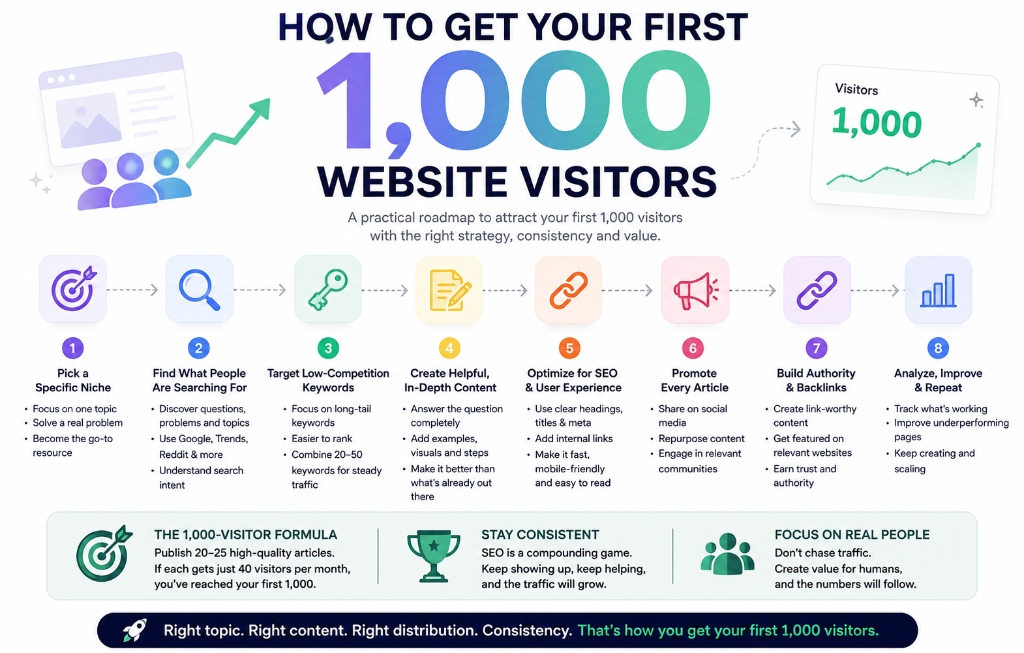

1. Pick a Specific Niche
The biggest mistake new websites make is trying to write about everything.
A website about:
"Travel, technology, fitness, food, business, finance, and lifestyle"
has no clear reason for Google—or readers—to trust it.
Instead, start narrow.
For example:
Budget travel in India
Vegan baking
Personal finance for students
Web design for restaurants
AI tools for small businesses
Running for beginners
Interior design for small apartments
The more specific your audience, the easier it becomes to create content that actually solves their problems.
Think of it this way:
Broad niche → huge competition
Specific niche → smaller audience, but easier to become relevant
You can always expand later.
2. Find What People Are Actually Searching For
Don't start by asking:
"What do I want to write about?"
Start by asking:
"What does my audience want to know?"
People are already searching for questions, problems, comparisons, tutorials, and recommendations.
For example, instead of writing:
"The Ultimate Guide to Running"
you could target specific searches such as:
How to start running as a beginner
How many kilometers should a beginner run?
What should I eat before running?
How to improve running stamina
Best running shoes for beginners
Why do my knees hurt after running?
These searches give you something extremely valuable:
search intent.
Tools such as Google Search, Google Trends, Ahrefs, Semrush, and even Reddit can help you discover what people are asking.
You don't need expensive software when you're starting.
Google itself can reveal a surprising amount.
Search your topic and look at:
Autocomplete suggestions
"People also ask"
Related searches
Competitor articles
Questions people repeatedly ask
Build your content around those questions.
3. Start With Low-Competition Keywords
Your first goal isn't to rank for:
"Best laptops"
or
"Digital marketing"
or
"Fitness."
Those keywords are extremely competitive.
Instead, look for long-tail keywords.
For example:
Competitive:
running shoes
More specific:
best running shoes for beginners
Even more specific:
best running shoes for beginners under ₹5,000
The longer and more specific the search query, the smaller the potential audience—but often the easier it is to rank.
Your first 1,000 visitors don't need to come from one massive keyword.
They can come from 20–50 smaller keywords.
That's often a much more realistic strategy.
4. Create Content That Actually Solves the Problem
Once you've found a topic, don't write 800 words just because someone told you that "SEO articles need 800 words."
Word count isn't the goal.
Solving the reader's problem is the goal.
If someone searches:
"How to start a blog"
they don't want 2,000 words of history about blogging.
They want to know:
What platform should I use?
How do I choose a niche?
How do I buy a domain?
How do I publish my first article?
How do I get visitors?
How long does it take to get traffic?
How can I eventually make money?
Give them those answers.
A useful article should leave the reader thinking:
"That answered exactly what I was looking for."
That's the kind of content people bookmark, share, reference, and link to.
5. Make Your Articles Better Than the Results Already Ranking
Before writing an article, search your target keyword.
Open the first page of results.
Now ask:
Can I genuinely make something better?
Look for gaps.
Maybe the existing articles:
Are outdated
Don't include examples
Have poor explanations
Are difficult to navigate
Don't answer important questions
Have weak visuals
Don't provide actionable steps
Ignore beginners
Are unnecessarily long
That's your opportunity.
Don't simply rewrite what's already there.
Improve upon it.
Add original examples, data, screenshots, templates, calculations, experiences, comparisons, or explanations.
The goal isn't to create another version of the same article.
The goal is to create the article you wish existed when you started researching the topic.
6. Write Headlines People Want to Click
Getting ranked is only half the battle.
Someone still needs to click.
Compare:
"Website Traffic Strategies"
with:
"How to Get Your First 1,000 Website Visitors"
The second one immediately communicates:
Who it's for
What they'll achieve
What the article is about
Good headlines create a clear promise.
Some useful headline structures include:
How-to
How to Get Your First 1,000 Website Visitors
Number
7 Ways to Get Website Traffic Without Paying for Ads
Problem
Why Your Website Gets Traffic but No Customers
Curiosity
The Traffic Strategy Most New Websites Ignore
Transformation
From 0 to 1,000 Visitors: A Beginner's Traffic Roadmap
Don't use clickbait that the article can't deliver on.
A high-click headline followed by disappointing content will hurt your credibility.
7. Optimize the Page for Search Engines
Once your content is good, make it easy for search engines to understand.
Use your primary keyword naturally in:
Page title
URL
Introduction
Main heading
Relevant subheadings
Meta description
Image alt text where appropriate
But don't stuff the keyword into every sentence.
Google doesn't need to see:
website visitors website visitors website visitors
50 times.
It needs to understand the topic and meaning of your page.
Use related concepts naturally.
For an article about getting website visitors, those might include:
organic traffic
SEO
search rankings
keywords
content marketing
backlinks
social media
search intent
Google Search
Write for humans first.
Optimize for search engines second.
8. Make Your Website Fast and Easy to Use
Imagine finally getting someone to click your Google result.
They arrive.
The page takes five seconds to load.
The text is tiny.
A popup covers the screen.
They leave.
You've lost the visitor.
Your website should be:
Fast.
Mobile-friendly.
Readable.
Easy to navigate.
Secure.
And free from unnecessary distractions.
Pay particular attention to mobile users.
A large percentage of web traffic comes from mobile devices, and a beautiful desktop website can still provide a terrible experience on a phone.
Your content can't generate traffic effectively if your website makes people leave.
9. Don't Publish One Article and Wait for Google
This is where many beginners give up.
They publish an article and expect traffic immediately.
SEO usually doesn't work that way.
Instead, build a content cluster.
Suppose your niche is running.
You might create:
Pillar article
The Beginner's Guide to Running
Then supporting articles:
How to Start Running
How Far Should Beginners Run?
How to Improve Running Stamina
What to Eat Before Running
Best Running Shoes for Beginners
How Many Days a Week Should You Run?
Common Running Mistakes Beginners Make
Now your website has depth around one subject.
You can link these articles to one another.
This helps readers discover more content and helps search engines understand the relationship between your pages.
10. Internal Linking Is Your Secret Weapon
Whenever you publish a new article, look for opportunities to link to your other relevant pages.
For example:
If you're just starting out, check out our guide on how to choose your first running shoes.
That link does two things.
It helps the reader.
And it helps search engines discover and understand your content.
Don't randomly add dozens of links.
Link where the additional page genuinely helps the reader.
Think of your website as a connected network rather than a collection of isolated articles.
11. Promote Every Article
Publishing isn't distribution.
When you publish an article, don't just leave it sitting on your website.
Turn one article into multiple pieces of content.
For example, one blog post can become:
1 blog article
↓
1 LinkedIn post
↓
3–5 short social posts
↓
1 infographic
↓
1 email
↓
1 Reddit/community discussion
↓
1 short video
↓
Several Pinterest graphics
You don't need to create everything from scratch.
You're repackaging the same useful idea for different audiences and platforms.
Your website is the destination.
Your other channels are distribution.
12. Participate in Communities
Communities can be an excellent source of your first visitors.
Depending on your niche, that could include:
Reddit
Quora
Facebook groups
LinkedIn
Discord communities
Industry forums
Niche communities
But don't spam your links.
Nobody likes:
"Great question! Check out my website: example.com"
Instead, contribute something genuinely useful.
Answer the question.
Explain the problem.
Provide an example.
Then, if your article contains a deeper explanation, you can reference it where appropriate.
Give value first.
Traffic comes second.
13. Start Building Backlinks
A backlink is a link from another website to yours.
Search engines can use links as signals for discovering content and understanding the web's structure, and links from relevant, reputable websites can help your site's visibility.
But don't buy hundreds of random backlinks.
Focus on earning relevant ones.
You can create link-worthy resources such as:
Original research
Statistics
Free tools
Calculators
Templates
Industry reports
Original graphics
Comprehensive guides
For example, instead of writing another generic article about website design, you could publish:
"2026 Website Design Pricing Report: What Businesses Actually Pay"
That kind of resource gives other websites something worth referencing.
14. Use Your Existing Network
Your first visitors don't have to be strangers.
Tell people about what you're building.
Send the article to:
Friends
Colleagues
Contacts
Communities
Professional contacts
Existing email subscribers
If you already have an audience somewhere, use it.
Even 50 people reading your article can be valuable if those people are the right 50 people.
Don't obsess over raw traffic.
Pay attention to relevant traffic.
15. Track What Is Actually Working
Install analytics and search-performance tracking.
You want to know:
How many people visit
Where they come from
Which pages they visit
Which keywords bring impressions
Which pages get clicks
How long people stay
Which pages lead to conversions
Then look for patterns.
Suppose you publish 20 articles.
Five receive almost no impressions.
Three receive some impressions.
Two suddenly start gaining traffic.
Those two are interesting.
Study them.
Why are they working?
Maybe the topic has more demand.
Maybe the keyword is easier.
Maybe the article is better.
Maybe other websites are linking to it.
Use your data to decide what to create next.
The 1,000-Visitor Strategy
You don't need one article to generate 1,000 visitors.
Think about it differently.
Imagine you publish 25 useful articles.
If each article eventually generates an average of:
40 visitors per month
you've reached:
25 × 40 = 1,000 monthly visitors
That's much more achievable than trying to create one viral article.
And some articles will eventually generate hundreds or thousands of visitors while others generate very little.
That's normal.
Your job is to keep increasing the number of high-quality entry points into your website.
A Simple 30-Day Plan
Week 1 — Research
Choose your niche. Identify your target audience. Find 20–30 relevant search queries. Study the pages currently ranking for those topics. Create your content calendar.
Week 2 — Create
Publish 3–5 genuinely useful articles. Focus on answering specific questions. Add internal links. Optimize titles, headings, URLs, images, and metadata. Make sure everything works well on mobile.
Week 3 — Distribute
Promote every article. Turn your articles into social posts. Share useful insights in relevant communities. Reach out to people who might genuinely find the content useful. Start building relationships with websites and creators in your niche.
Week 4 — Analyze and Improve
Look at your analytics. Find pages receiving impressions but few clicks. Improve their headlines and descriptions. Find articles beginning to rank. Expand and improve them. Add internal links. Identify new keywords based on what people are actually searching for. Then repeat the process.
What You Should NOT Do
There are a few tempting shortcuts that usually waste your time.
Don't buy fake traffic.
10,000 meaningless visits aren't better than 100 relevant visitors.
Don't keyword-stuff.
Writing awkward sentences just to repeat a keyword isn't good SEO.
Don't copy competitors.
Study them. Learn from them. Then create something better.
Don't publish AI-generated filler.
AI can dramatically speed up research, outlining, editing, and content production. But generic content that says nothing new won't magically rank because it was generated by AI. Use AI as a tool. Add your own expertise, examples, data, opinions, and experience.
Don't give up after 30 days.
SEO is a compounding game. The article you publish today can continue generating visitors months or even years from now.
The Real Goal Isn't 1,000 Visitors
Here's the most important part.
1,000 visitors isn't the finish line.
It's proof that you've built a system capable of attracting people.
Once you understand how to:
Find demand → Create useful content → Get discovered → Earn clicks → Keep visitors → Convert them
you can scale the system.
1,000 visitors becomes 10,000. 10,000 becomes 100,000.
And eventually, your website can become an acquisition channel rather than simply an online brochure.
That's when things get interesting. Because the real question isn't:
"How do I get 1,000 visitors?"
It's:
"How do I turn the right 1,000 visitors into customers?"
And that's where traffic becomes a business.
Related ResourcesFree Press Release Templates (2026)30+ TV Channels at a Mumbai Press Conference: The Full Story→ PR & Media Relations Services→ View Media Mirch Case Studies
PLAN YOUR PR STRATEGY WITH MEDIA MIRCH
From media list curation and press release writing to national TV campaigns — we handle the entire process so you can focus on your message.

