

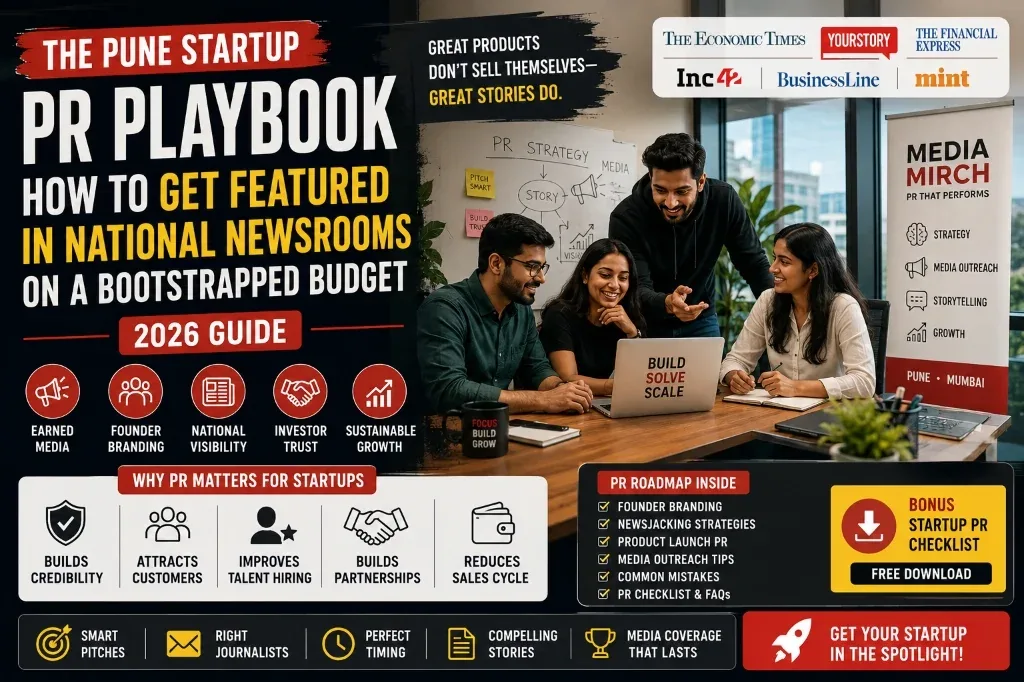

Investors, customers, partners, and talent are more likely to notice startups that consistently appear in trusted media. Here's how founders can build visibility without exhausting their marketing budget.
In Pune's rapidly expanding startup hubs—from the tech parks of Hinjawadi and Magarpatta to the creative workspaces of Baner and Koregaon Park—founders share a common struggle. They build innovative products, hire dedicated teams, and burn the midnight oil, yet they remain largely invisible to the national market. They spend massive portions of their early capital on social media ads, only to watch lead acquisition costs rise while organic trust remains low.
The solution is not to double down on paid marketing budgets, but to focus on Public Relations (PR). Earned media—features in leading publications like *The Economic Times*, *YourStory*, *The Financial Express*, or regional dailies like *Sakal* and *Lokmat*—creates a level of trust that paid banners cannot match. This guide is a step-by-step playbook designed to help bootstrapped Pune startups secure national news features without paying massive retainers.
Why Great Startups Stay Invisible
Building a great product or service is no longer enough to secure market share. In India's crowded market, hundreds of startups launch every week. Many of these businesses have comparable products, similar messaging, and identical features. Journalists do not search corporate directories looking for companies to write about. They look for stories.
During the early growth stages, many founders dismiss PR as a luxury reserved for venture-backed companies. They focus entirely on engineering, product updates, or direct sales. While these operations are critical, staying invisible outside your immediate user base limits your capacity to hire top-tier talent, partner with major enterprises, or secure institutional funding. Visibility builds the credibility that shortens sales cycles and lowers investor hesitation.
Paid Advertising vs. Earned PR: What's the Difference?
Many early-stage founders confuse digital marketing with public relations. While both aim to grow the business, they operate on different principles and deliver different outcomes:
Paid Advertising | Earned PR |
|---|---|
You pay for visibility: Ad space is purchased (Google, LinkedIn, Facebook). | Media chooses to cover you: Journalists publish based on editorial merit. |
Stops immediately: Traffic ceases the day your ad budget ends. | Builds long-term credibility: Articles remain searchable, building permanent domain authority. |
Promotional message: Self-declared claims that audiences often view with skepticism. | Third-party validation: Respected publications endorse your significance. |
Short-term conversions: Drives immediate transaction attempts. | Long-term reputation: Builds trust that facilitates recruitment and partnerships. |
PR and paid marketing are not mutually exclusive. Instead, they complement each other. The most effective campaigns use PR to build the baseline brand trust first, making your digital ads convert at a significantly lower cost.
What Makes a Startup Newsworthy?
Journalists do not write promotional brochures. The most common reason startup pitches fail is that they read like advertising copies. If your email contains sentences like "We offer the most advanced, user-friendly platform at an affordable price," it will be deleted. To get published, you must frame your company around genuine news hooks:
Funding Announcements: Verifiable investment rounds from recognized angel networks or VC firms are standard business news.
Product Innovation: Solving a hard, technical problem in a way that has not been done before in India.
Customer Impact: Documented data showing how your solution saved a client massive costs or solved a major community problem.
Expansion: Launching services in new regional markets, creating jobs, or building local infrastructure.
Founder Journey: Exceptional personal narratives of overcoming structural adversity to build the business.
Technology Breakthroughs: Original patents, AI developments, or deep-tech research validated by independent bodies.
The Startup PR Roadmap
A successful PR campaign follows a structured sequence. Do not attempt to pitch the national press before your foundations are established.
Stage 1: Before the Launch (The Infrastructure)
Prepare your media assets. Draft a clear, fact-based company profile. Write a concise biography for the founders. Secure professional headshots in corporate settings. Build your media kit (including logos, product screenshots, and executive quotes) and save it in an accessible Google Drive folder.
Stage 2: The Launch (The Announcement)
Execute your primary announcement. Reach out to targeted beat journalists with personalized email pitches. Coordinate social announcements on LinkedIn. Distribute your press release to regional business desks to capture local print coverage in Pune and Western Maharashtra.
Stage 3: Sustaining Growth (The Thought Leadership)
PR doesn't end with a product announcement. Keep your company in the press by pitching founder opinion pieces on industry trends, participating in B2B podcasts, securing speaking panel slots at business conferences, and sharing proprietary data reports.
Founder Branding: Why Investors and Journalists Buy Into People
In the startup ecosystem, journalists and investors follow people, not entities. A startup's profile is directly tied to the public authority of its founders. If you are a founder, building your personal brand is a strategic business asset.
You can start B2B branding without a PR agency. Share original, detailed commentary on LinkedIn addressing challenges in your industry. Write opinion pieces for digital trade magazines. Participate as a guest speaker on niche podcasts. When editors see that you consistently share valuable, non-promotional insights, they will begin calling you for quotes and expert commentary when industry news breaks.
How to Use Newsjacking Without Looking Opportunistic
Newsjacking is the practice of aligning your brand's expertise with breaking news stories. In 2026, with fast-moving news cycles, this is one of the most effective ways for bootstrapped startups to secure national coverage.
When major news breaks—such as new AI data regulations, Union Budget updates, funding policy changes, or significant tech mergers—national journalists must write follow-up stories within hours. They need expert quotes. If you can deliver a 150-word, highly analytical quote directly addressing the impact of that news to a journalist covering the story, you can secure a feature quote in next morning's edition. Keep your commentary strictly analytical—never mention your product directly.
Launching Your Product the Right Way
A product launch press release should follow the inverted pyramid structure: the most important news at the very top, followed by secondary details, customer quotes, and company background. Keep the text under 500 words.
Alongside the release, offer journalists a live demonstration or a temporary demo login. Providing hands-on access to your software or physical product shows that your announcement is backed by real engineering, not just marketing hype.
Media Outreach: Quality Beats Quantity
Do not buy general media contact databases and send mass email campaigns to 500 editors. It does not work. It flags your domain as spam and ensures you are ignored.
Instead, identify the 15–20 journalists who regularly cover your specific startup domain (Fintech, SaaS, DeepTech, ClimateTech). Read their last three articles. Write a personalized, direct email pitch showing you understand their beat, explaining why your story is relevant to their readers, and proposing a brief phone call or interview. Personalized outreach has a 10x higher response rate than mass emailing.
Media Mirch Tip:Keep email pitches under 150 words. Journalists have seconds to scan their inbox. State the news hook immediately, explain why it matters, and offer a clear next step.
Common Startup PR Mistakes
❌ Sending promotional marketing pitches: Frame your email around news value, not sales copy.
❌ Pitching every journalist: Build a curated list. Do not send deep-tech startup news to a lifestyle reporter.
❌ No media kit available: Make sure images, logos, and profiles are immediately accessible via a link.
❌ Weak founder profiles: Ensure the founder's LinkedIn profile is polished and professional before pitching.
❌ Lacking customer validation: Include real case studies or statistics showing customer impact.
Startup PR Checklist
Check off these essential assets before initiating your PR campaign:
✓ | Asset | Requirement |
|---|---|---|
□ | Founder Bio | Concise 150-word profile highlighting career highlights and credentials. |
□ | Company Backgrounder | One-page document detailing mission, products, market scale, and locations. |
□ | Media Kit Folder | Google Drive folder containing high-res headshots, logos, and product visuals. |
□ | Target Journalist List | 15–20 beat-relevant reporters with active contact details. |
□ | Press Release Draft | News-style announcement detailing the release, funding, or expansion. |
Frequently Asked Questions
Should an early-stage startup invest in PR?
Yes, but do not sign expensive long-term retainer agreements. Instead, focus on project-based PR support around major milestones (like launching a product or closing a seed round) to build your initial market validation.
What is the difference between marketing and PR?
Marketing is paid communication designed to generate direct sales (such as search engine ads). PR is earned validation focused on building brand authority, trust, and search engine credibility through journalists and third-party media.
When should startups approach journalists?
Reach out to journalists only when you have a genuine news hook—such as securing funding, launching a major product upgrade, initiating a large partnership, or releasing proprietary industry research. Do not pitch standard company updates that lack broader public interest.
Can bootstrapped startups earn national media coverage?
Yes. National business publications focus on compelling stories, innovative technologies, and unique founder journeys. Having a massive funding round is one way to make the news, but offering an interesting angle on current market trends is equally effective.
How much does startup PR cost in India?
Project-based startup PR services in Pune range from ₹35,000 for local media announcements to ₹1,50,000+ for national press releases and comprehensive founder thought leadership campaigns.
Do startups need a press release for every launch?
No. Save press releases for major announcements that impact your market or interest target customers. Minor updates are better suited for company blogs, newsletters, or social media channels.
Is LinkedIn important for founder branding?
Yes, LinkedIn is the primary channel for business founder branding in India. Sharing original, non-promotional industry insights helps build an audience of potential partners, clients, and media contacts.
Can regional startups appear in national business media?
Yes. Pune's startup ecosystem has national visibility. Pitching your story to the regional bureaus of national dailies (like *The Economic Times* or *Times of India* in Pune) is a highly effective way to secure national business features.
Put Your Startup in the Spotlight
Whether you're raising funding, launching your first product, or building your founder brand, Media Mirch handles your complete startup communications. We partner with Pune and Indian startups to earn credibility that advertising alone cannot buy.
Book a Startup PR CallView Our ServicesRelated Resources→ What Does a PR Agency Do?Free Press Release Templates (2026)30+ TV Channels at a Mumbai Press Conference: The Full StoryThe Indian Author's Launchpad: 2026 PR Guide
PLAN YOUR PR STRATEGY WITH MEDIA MIRCH
From media list curation and press release writing to national TV campaigns — we handle the entire process so you can focus on your message.

