

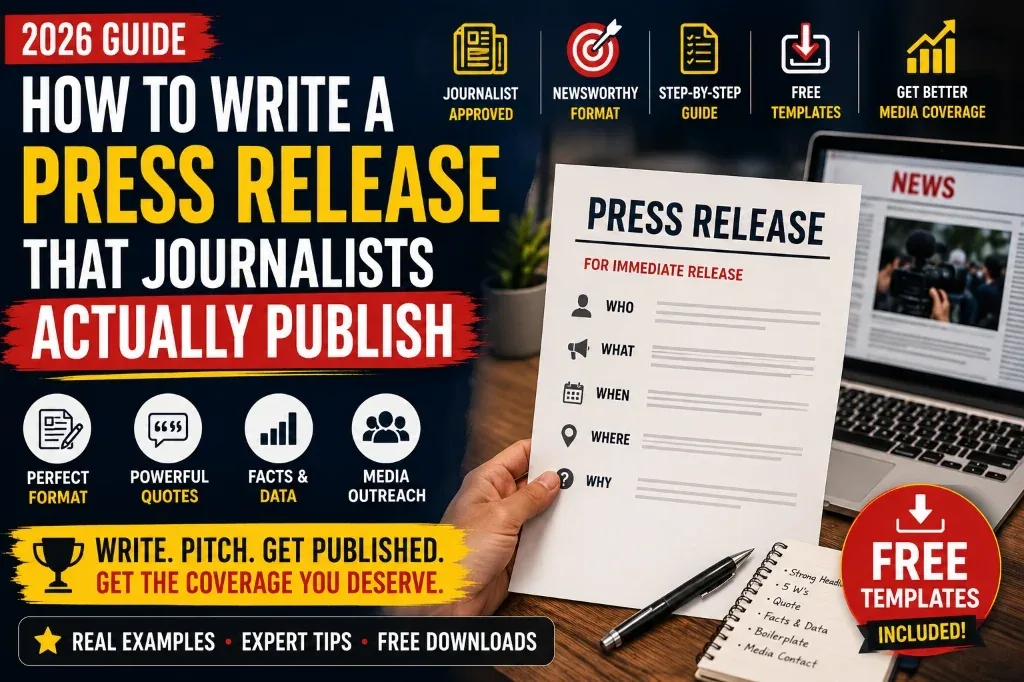

Quick Answer (Featured Snippet):
A professional press release should include a compelling, objective headline, a dateline (city and release date), an opening paragraph answering the five W's (Who, What, When, Where, Why), supporting body paragraphs with verified statistics, an authentic executive quote, a clean company boilerplate, and clear media contact details. To ensure publication, it must be written from an objective, editorial perspective rather than as marketing copy or sales advertising, and it must contain a genuine, newsworthy angle that interests a publication's readership.
Table of Contents
1. What is a Press Release?
A press release—sometimes referred to as a news release or media release—is an official, written communication sent by an organization, company, or individual to members of the news media. Its primary purpose is to announce something newsworthy, factual, and timely, in a format that makes it easy for reporters and editors to adapt it into a news story.
Unlike marketing brochures or social media advertisements, a press release is not intended for the general public directly. It is a business-to-business document written specifically for journalists. The goal is to secure "earned media" coverage—which is significantly more credible than paid advertising because it carries the third-party validation of an independent news outlet.
Businesses use press releases to establish a public record of key corporate milestones. Whether launching a product, announcing a merger, or managing a corporate crisis, a press release ensures that the company's official position, facts, and verified quotes are clearly stated and easily accessible to editors across print, television, and digital platforms.
2. When Should You Write a Press Release?
The single most common mistake organizations make is assuming that every internal company update is worthy of a press release. In the PR industry, this is known as "announcement fatigue." If you bombard journalists with non-news, they will quickly filter your email address into their spam folders. To earn media coverage, your announcement must possess genuine news value.
Here are the classic milestones that justify writing and sending a press release:
Product Launch: Announcing a new product or service that addresses a major market gap or introduces a unique technology.
New Office or Expansion: Opening a physical headquarters or expanding services into a new state or country, especially when it creates local jobs.
Funding & Investments: Securing venture capital, private equity, or seed funding rounds (critical for startup ecosystems).
Partnerships & Collaborations: A strategic alliance between two distinct companies that results in a new product offering or significantly alters the industry landscape.
Awards & Recognitions: Receiving a reputable industry award or achieving a major certification milestone.
CSR Initiatives: Major corporate social responsibility programs that make a measurable, positive impact on local communities.
Book Launches: Authors introducing a new publication with clear thematic and cultural relevance.
Sports Tournaments: Announcing state or national championships, team selections, and major sponsorships.
Government & Policy: Policy changes, municipal announcements, and regulatory frameworks impacting specific sectors.
Public Events & Press Conferences: Announcing a major exhibition, public forum, or the scheduling of a media brief.
Before putting pen to paper, ask yourself: "If I did not work for this company, would I read this story in tomorrow's newspaper?" If the answer is no, it is a blog post or an advertisement, not a press release.
3. Why Journalists Ignore 90% of Press Releases
To write a successful press release, you must understand the daily reality of the journalist. The average editor at a major Indian national daily (such as The Times of India or The Economic Times) receives between 150 to 300 press releases in their inbox every single day. They have less than 5 seconds to scan your email and decide whether to bin it or read further.
Here is why 90% of press releases are immediately deleted:
Promotional & Hyperbolic Language: Using words like "revolutionary," "state-of-the-art," "best-in-class," or "groundbreaking" screams advertising. Journalists write facts, not promotional hype.
Weak, Clickbait Headlines: If the headline reads like a marketing pitch or does not clearly state the news, editors will pass.
No Real News Angle: Announcing that your company has updated its logo or that the CEO attended a routine business lunch is not news.
Lack of Hard Data: Announcements that lack statistics, financial figures, or verifiable research are dismissed as fluff.
Spammy Mass Emailing: Sending a tech startup funding announcement to a lifestyle reporter or a crime editor is a waste of time.
Poor Formatting & Long Blocks of Text: If an editor has to spend 15 minutes trying to find the contact info or rewrite long, wordy paragraphs, they will delete it.
Generic, Robotic Quotes: Quotes that say "We are thrilled to launch this new service..." add zero editorial value.
4. Before You Start Writing
Preparation is the key to writing a press release efficiently. Gather all necessary assets and verify details before starting. This prevents constant rewriting and ensures accuracy.
Create a pre-writing folder containing the following items:
The Core Facts: Exact names, dates, times, addresses, and quantities.
Data and Statistics: Verified percentages, revenue figures, hiring counts, or market growth figures.
Executive Quotes: One or two pre-approved quotes from key executives or partners. Ensure they sound like natural speech, not a legal contract.
Supporting Media Assets: High-resolution photos, infographics, or product mockup links. Include clear captions and photographer credits.
Boilerplate Information: Up-to-date paragraph summarizing your company's history, mission, and scale.
Media Contact Person: The name, mobile number, and email address of the dedicated spokesperson or PR coordinator.
5. How to Write a Press Release Step-by-Step
Step 1: Write a Headline That Sounds Like News
The headline is the most critical element of your press release. It is the first (and often the only) thing a journalist reads. A great headline must be factual, objective, and announce the core news immediately.
❌ Bad Example:
"XYZ Corp Launches the Most Revolutionary cloud Platform Ever to Blow Away Competitors"
Why it fails: It uses advertising hyperbole, lacks specific details, and sounds like sales copy.✅ Good Example:
"XYZ Corp Launches Cloud Platform to Reduce Small Business Invoice Processing Time by 40%"
Why it works: It states exactly who is releasing the product, what it does, and provides a clear, measurable benefit supported by statistics.
Step 2: Add the Dateline
The dateline anchors your news in time and space. It tells the reader where the news is originating and when it is being published. It is formatted at the very beginning of the opening paragraph in bold uppercase letters.
Format example: MUMBAI, India – July 13, 2026 – Today, XYZ Corp announced...
Step 3: Answer the Five W's
The opening paragraph (the "lead") must summarize the entire story in two to three sentences. Do not make the journalist search for the news. If they stop reading after the first paragraph, they should still know exactly what the story is about.
The Five W's Framework
Who: The company, organization, or person making the announcement.
What: The product, partnership, expansion, event, or announcement itself.
When: The date of the launch, event, or implementation.
Where: The geographical location or operational market affected.
Why: The reason behind the news—why it matters to the industry or public.
Step 4: Add Supporting Information
The second and third paragraphs provide the essential details, context, and statistics. Explain how the product works, reference the market research or industry problems that necessitated this launch, and outline future targets or expansion plans.
Step 5: Include a Human Quote
Quotes should provide perspective, passion, and context. Do not use quotes to state facts that can easily be written in plain text. Use them to express the vision, the long-term industry impact, or the strategic intent of the leadership.
"This platform is the culmination of two years of engineering focus. By automating repetitive backend tasks, we are freeing up local accounting teams to focus on strategic financial planning," said Meenal Mahajan, Founder of XYZ Corp.
Step 6: Add Company Boilerplate
The boilerplate is a short "About us" section positioned under the separator symbol (###). It acts as an official mini-bio of the company, detailing when the company was founded, its core mission, scale, and a link to the corporate homepage.
Step 7: Media Contact
Include name, designation, telephone/mobile number, email address, and press room website URL. Make sure the listed contact person is actively checking their phone and email the day the release is sent.
✍️ Editor's Red Pen: Before & After Comparison
The table below demonstrates how editorial PR professionals rewrite corporate promotional copy into objective, newsroom-ready sentences:
❌ Before (Marketing Copy) | ✅ After (Editorial Copy) |
|---|---|
"XYZ Company is proud to announce its revolutionary cloud platform designed to destroy competitors and change the accounting space forever." | "XYZ Company today launched a cloud-based platform designed to reduce invoice processing time by 40% for small businesses." |
"We have a spectacular state-of-the-art office in Mumbai that will house our brilliant team of software engineers." | "The company opened a new 10,000 sq. ft. engineering center in Mumbai, creating jobs for 50 software developers." |
"Our software is insanely fast, and customers are absolutely in love with the user-friendly interface we created." | "A beta test involving 500 active users showed a 30% increase in database query speeds compared to legacy tools." |
6. Standard Press Release Structure
Below is the visual code block demonstrating the standard formatting structure expected by newsrooms:
FOR IMMEDIATE RELEASE
HEADLINE: [Announces the News & Factual Benefit in Bold]
SUBHEADLINE: [Provides Extra Context or Statistics in Lowercase]
DATELINE: [CITY, Country – Month Day, Year] – [Opening Paragraph: Answers the 5 W's]
[Supporting Paragraph: Delivers Details, Industry Context, and Data Points]
[Executive Quote: CEO or Founder explains the vision and impact]
[Additional Context: Future plans, pricing, or product availability]
### [Centered Separator Symbol]
About [Company Name]: [Company Boilerplate Paragraph]
Media Contact:
Name: [Spokesperson Name]
Designation: [e.g. PR Director]
Email: [contact@company.com]
Phone: [+91 9X XXX XXXXX]
Website: [www.company.com]
7. Complete Press Release Example
The example below represents a professional press release ready for newsroom submission:
FOR IMMEDIATE RELEASE
Media Mirch Launches Bilingual Press Release Writing Hub for Maharashtra Startups
New service aims to improve corporate visibility in regional Marathi media and national English dailies.
PUNE, India – July 13, 2026 – Media Mirch, a leading public relations agency in Western India, today announced the launch of its dedicated bilingual press release writing hub. The new service is designed specifically to help startups translate complex technical milestones into localized, newsroom-ready stories for over 100 regional Marathi newspapers and national English newsrooms across Maharashtra.
The service addresses a major bottleneck in regional public relations. According to internal data compiled by Media Mirch, over 75% of English press releases sent to regional Marathi journalists are ignored due to formatting errors and translation discrepancies. The bilingual hub resolves this by utilizing native Marathi journalists to craft custom, culturally relevant narratives that retain the technical accuracy of the brand.
"Startups often struggle to communicate their news effectively to regional language desks, which represent the largest print readership base in India. Our new hub guarantees that announcements are professionally written and targeted directly to editors who cover their specific niche," said Meenal Mahajan, Founder and PR Director at Media Mirch.
The bilingual writing service is available starting today. Startups can download free formatted press release templates directly from the Media Mirch resource library to structure their draft content.
###
About Media Mirch:
Founded in 2020, Media Mirch is a premier public relations and communications agency specializing in corporate visibility, startup PR playbooks, and regional press conference management in Pune and Mumbai. The agency represents a diverse portfolio of clients across technology, healthcare, and education sectors. For more information, visit www.mediamirch.com.
Media Contact:
Name: Rahul Deshmukh
Designation: Digital Marketing Lead
Email: press@mediamirch.com
Phone: +91 93702 13100
Website: www.mediamirch.com
8. Different Types of Press Releases
Understanding the context of your announcement determines its structure and internal formatting. Different categories of organizations require different styles of press releases:
Corporate Press Release: Announcements relating to earnings, mergers, executive hiring, or board updates. Requires a highly formal tone. Reference templates at Free Press Release Templates (2026).
Startup Press Release: Announcing product launches, seed rounds, and operational expansions. Needs high focus on product utility and market problems. See resources at The Pune Startup PR Playbook: 2026 Guide.
Hospital & Healthcare PR: Medical updates, clinical achievements, and hospital launches. Highly sensitive, requiring strict medical fact validation. Link to Free Marathi Press Release Templates: School, Hospital & Event.
NGO & Charity PR: Social welfare drives, fundraisers, and community programs. Highlight the human-interest angle. Use formats at Free Marathi Press Release Templates: Corporate, Government & NGO.
Government Press Release: Legislative announcements, city updates, and public notices. Extremely formal structure. See Free Marathi Press Release Templates: Corporate, Government & NGO.
Sports Event Press Release: Tournament announcements, championship schedules, and selections. Focus on competitive results. Details at Beyond the Ring: Securing National Sports Tournament Coverage.
Book Launch Press Release: Authors introducing new works to critics and readers. Highlights themes, genres, and launch events. Layout at The Indian Author's Launchpad: 2026 PR Guide.
School & College PR: Academic achievements, sports achievements, and campus exhibitions. Refer to Free Marathi Press Release Templates: School, Hospital & Event.
Exhibitions & Events: Venue launches, product exhibitions, and press meets. Read the full case study at 30+ TV Channels at a Mumbai Press Conference: The Full Story.
9. AI vs. Human Press Release Writing
With the rise of generative AI platforms like ChatGPT, writing a press release has become deceptively fast. While AI is an excellent tool for structural brainstorming or formatting summaries, it has introduced serious risks to brand credibility in newsrooms.
Journalists are rapidly developing "AI fatigue." Because AI models are trained on generic data, they output highly repetitive phrases (like "delighted to announce," "innovative solution," or "paving the way for the future") that immediately flag the email as spam. More dangerously, AI often hallucinates quotes that sound robotic, legally rigid, or completely detached from natural human speech.
A professional human PR writer checks every fact, conducts interviews to draft organic quotes, and structures the story based on active newsroom constraints. If you use AI to draft your content, ensure it is thoroughly edited by a human copywriter to remove generic adjectives and verify all data points before pitching.
10. Press Release Checklist
Before sending your press release to any newsroom, ensure you can check off every item on this quality control checklist:
Headline: Factual, objective, under 85 characters, with a clear news angle.
Dateline: CITY, Country – Date format present at the start of the lead paragraph.
The 5 W's: All essential details summarized in the first 3 lines.
Executive Quote: Pre-approved quote that sounds organic and provides visionary context.
Boilerplate: Short summary paragraph of the company with a website link.
Contact Info: Name, active phone number, and professional email of the PR contact.
Media Assets: High-resolution image link included (or attached without bloating the email).
Document Formats: Text copyable from email body, with a backup .doc or Google Docs link (avoid sending raw locked PDFs).
11. Common Mistakes to Avoid
Steer clear of these common pitfalls to maintain corporate credibility and earn editorial interest:
Writing for Customers Instead of Journalists: A press release is not a sales page. Avoid call-to-actions like "Buy now!" or "Sign up today!" inside the article body.
Too Many Adjectives: Cut out adjectives like "amazing," "incredible," or "groundbreaking." Stick to nouns and verbs that describe the factual accomplishment.
Missing Dateline or Contact Info: If a reporter cannot easily contact you for a follow-up interview within 5 minutes, they will drop the story.
No Financial or Statistical Data: Newsrooms need numbers. Avoid vague statements like "We grew significantly." Instead, write: "The company reported a 45% quarter-on-quarter increase in active users."
Sending the Press Release as a Huge Image: Never send a press release as a Jpeg or a scanned PDF. A journalist cannot copy text from an image, and they will not waste time manually retyping your announcement.
12. How to Send a Press Release to Indian Media
Writing a great press release is only half the battle; distributing it to the right editors determines its success. Follow these guidelines for outreach:
Timing is Critical: The best days to send a press release to Indian newspapers are Tuesday, Wednesday, and Thursday. Avoid Mondays (editorial teams are planning weekly agendas) and Friday afternoons. Pitch between 10:00 AM and 12:30 PM. Never pitch late in the evening when editors are scrambling to meet page-layout deadlines.
Keep Emails Personalized: Never bulk-CC 100 journalists in one email. It looks spammy and disrespectful. Send personalized individual emails or BCC them securely. Mention their name, reference their recent articles, and state why your announcement is relevant to their specific beat.
Write a Clear Subject Line: The subject line should be the news headline, prefixed with [PR Announcement] or [News Release]. Keep it brief and clear.
Refer to Local Contacts: Always build a targeted regional list. For Maharashtra-based campaigns, refer to the verified database at Maharashtra Media Contacts (2026).
13. Frequently Asked Questions (FAQs)
Q1: What is the ideal length of a press release?
The ideal length is between 400 to 600 words. Keep it contained to a single page. If your release is longer than 800 words, you are likely writing unnecessary marketing fluff.
Q2: Can I use ChatGPT to write my press release?
You can use AI to format structure and draft outlines. However, avoid publishing generic AI text directly. Journalists instantly spot repetitive AI phrasing and will delete the pitch.
Q3: Should I attach a PDF to my pitch email?
No. Avoid attaching large PDFs as they can trigger spam filters. Paste the text directly into the email body and include a link to a Google Doc or Word document.
Q4: Which format is better: Google Docs or Microsoft Word (.doc)?
Both are acceptable. Provide a copyable Word attachment or a shareable view-only Google Docs link so reporters can easily copy and paste the text.
Q5: What is the best font for a press release?
Stick to clean, standard sans-serif fonts like Arial, Calibri, or Times New Roman. Use a 12pt size with clear double-spacing for readability.
Q6: Which is the best day to send a press release in India?
Mid-week (Tuesday through Thursday) is the most effective. Monday is too busy, and Friday afternoon is too close to the weekend.
Q7: What is the best time to send my release?
Send your email between 10:00 AM and 12:30 PM. This aligns with editors arriving at the newsroom and planning the afternoon layout grids.
Q8: How many journalists should I pitch to?
Focus on quality over quantity. Pitch to 15-20 highly targeted editors who actively cover your industry rather than mass-emailing 500 generic addresses.
Q9: Is it professional to follow up on a press release?
Yes, but only once. Send a brief, polite follow-up email 24-48 hours later. Never call editors repeatedly to ask "Did you read my email?"
Q10: Can early-stage startups send press releases?
Yes, if they have genuine news. Funding rounds, key hires, major client integrations, or product launches are excellent hooks.
Q11: Can NGOs send press releases?
Absolutely. NGOs should focus on community impact data, relief updates, public campaigns, and human interest stories.
Q12: Should schools and colleges send press releases?
Yes, for major academic board results, sports championships, campus construction updates, or student innovations.
Q13: Can hospitals send press releases?
Yes, hospitals should announce new specialized departments, medical breakthroughs, major success cases, or community health camps.
Q14: What is a boilerplate in PR?
A boilerplate is a standard 4-5 sentence summary paragraph at the bottom of the release that gives a brief profile of the issuing organization.
Q15: Should I include pricing in a product launch release?
Yes, if it is a consumer product. Transparent pricing and availability details are essential factual data points for editors.
Q16: Can I include multiple quotes in one release?
Keep it to a maximum of two quotes—one from your organization's spokesperson and another from a partner or key stakeholder.
Q17: What does 'FOR IMMEDIATE RELEASE' mean?
It tells editors that the information is ready for public distribution immediately. If it is under embargo, state the exact date and time it should be held.
Q18: What is the separator symbol (###) used for?
It is an old journalistic markup symbol that indicates the main body of the press release has ended. Information below this is background boilerplate.
Q19: How do I handle images?
Provide a link to a shareable Google Drive folder containing high-resolution Jpegs with caption details. Never attach huge images that exceed 5MB.
Q20: Why do press releases fail?
Most fail because they lack news value, read like commercial ads, are sent to the wrong writers, or lack contact information.
Need a Press Release That Gets Attention?
Writing a professional press release is only the first step. Media Mirch helps organizations define their news angle, craft newsroom-ready stories, and conduct targeted outreach to the right journalists to secure top-tier coverage.
PLAN YOUR PR STRATEGY WITH MEDIA MIRCH
From media list curation and press release writing to national TV campaigns — we handle the entire process so you can focus on your message.

